31 January 2007

Bulgarian Lentil Soup

I made this last Sunday, and thought I'd already added it to the cookbook, but apparently not, so here it is.

Ingredients

1 medium sized onion
2 tbsp oil
2 tbsp sweet paprika
1 l water
250 g unpeeled green dried lentils
2 - 3 cloves of garlic
1 large carrot
2 small green peppers
1 small celeriac or 4 - 5 Jerusalem artichokes (optional)
salt, pepper, parsley, dill, savory

Method
  1. Soak the lentils for at least 2 h in water, preferably overnight.
  2. Dice the onion, carrot, peppers and celeriac or Jerusalem artichokes, but keep each separate.
  3. Heat up the oil and fry the onion in it. Press in the garlic as well.
  4. When the onion/garlic have gone translucent, add the paprika, stir vigorously for about a minute and add the water - you need to have these ready, if the paprika is fried for too long, it burns and doesn't taste as nice. The water can be cold/room temperature, but it would speed things up a bit if it's hot. I never bother with that, though.
  5. Add the soaked lentils and carrots and whichever of the herbs that are dried. Also add the celeriac, if you decide to use this. I don't like celeriac, so I don't use it.
  6. Bring to the boil and leave to simmer for 15 - 20 minutes.
  7. Now add the pepper and leave to simmer for another 5 - 10 minutes.
  8. Add the Jerusalem artichokes and leave to simmer for further 5 - 10 minutes. Also add the fresh herbs, after chopping them. This is a new invention, I had some Jerusalem artichokes left over and I added them and it tasted really nice. You can skip them if you don't like them. It's important not to let them boil for more than 10 minutes, so that they don't disintegrate.
The soup is now ready and is nice on it's own. Some people add vinegar just before eating.

As usual, Lundulph needs meat and this week-end I got him a nice piece of unsmoked gammon, which I roasted as recommended in Delia Smith's 'How to cook'. I got two pieces of aluminium foil, placed them in a cross, put a bunch of thyme, sage and black pepper in the middle, placed the gammon on top, then put more thyme, sage and black pepper over it and wrapped up the foil into a parcel. Baked in the oven at gas mark 4 (180 degrees Celsius) for 1 h (Delia recommends 20 minutes per 1 lb meat + 20 minutes on top of that). Then I unwrapped the gammon, scraped off the herbs on the top and put it back in for another 30 minutes on gas mark 7 (230 degrees Celsius) to give it a bit of colour. Not sure if this was a good idea, it just seemed to try out. Lundulph said it was rather nice.

Next time he's asked me to cook the meat with the soup, so that it can pick up some of the flavours. We agreed to try thin strips of chicken or turkey breast.

I had the last of the soup today, so there's nothing to photograph. Sorry, will try to remember to add some next time.

22 January 2007

Kyopoolu

This is a quintessential Bulgarian dish. Well, the name of the dish sounds Turkish, so the whole dish is probably Turkish as well.

It is eaten as a "meze", that is a starter to line the stomach for the rakia. Lundulph likes to dip bread in it. I like it as a spread on toast.


Note that the quantities are very approximate.

Ingredients

7 (500 g) bell peppers
2 (600 g) aubergines
1 large clove of garlic
5 tbsp olive oil
3 tbsp chopped parsley
1 chili (optional)
3 tbsp chopped walnuts (optional)

Method
  1. Roast the peppers and the aubergines. Lundulph and I took the trouble of bringing back a pepper roaster from Bulgaria. This is basically a cannon-shaped device with ceramic inner walls, metal outer walls and a lid. It is powered by electricity, when it heats up, peppers and aubergines are put in, the opening is covered with the lid and a few minutes later the vegetable comes out roasted. I've seen one of the celebrity contestants of Masterchef roast a pepper with a mini blow torch, but the easiest would be to roast the peppers and aubergines directly on the hob, if you have an electrical one, or on a dry pan on a gas hob. Putting them under the grill would probably also do the trick, they need watching and turning. They are ready when the skin goes black. Place them in a deep casserole dish and cover with the lid and leave for 15 - 20 minutes. The chili is optional, but if you choose to add it, it should be roasted in the same way. Alternatively dried crushed chili can be used.
  2. At this point, it should be very easy to peel the peppers and aubergines. Remove also the seeds from the peppers and rinse off any remnants of skin. This is quite messy.
  3. Now place in a deep bowl, add the garlic, olive oil and salt and blend to a cream with a hand blender. Or if you have a food processor, that works as well. Alternatively, chop everything very finely and mix thoroughly.
  4. Add the chopped parsley and walnuts (we don't like kyopoolu with walnuts, so we don't put any in). Stir through.
If you do this quickly, the kyopoolu will still be warm when it's done and is very tasty with hot toast. But it's nice cold too. Store it in the fridge and stir through when serving after that.

I have successfully frozen it too, though it tends to go a bit watery afterwards. A better way is to roast peppers and aubergines, peel and wash them and then freeze in the right amounts. Then just blend together. As for garlic, if it's Friday, I tend to put more garlic in, as I like it as garlic-y as possible. Lundulph doesn't agree, reckoning the amounts I put in completely dominate the dish.

We had a Bulgarian meze dinner tonight with turshia, ham, toast and rakia, in addition to the kyopoolu. It was very nice indeed.

And what I fogot to mention is that on the picture above, I used 3 green, 2 red and 2 yellow peppers, which is why it looks a bit like poo. If you only use green peppers, the colour will be pine green and it'll taste less sweet. If you only use red peppers, then it'll be more orange in colour and taste sweeter too, of course.

An idea that just struck me is that if you cool it in the fridge, then pipe it onto small crackers or pieces of toast, it would make nice canapés.

14 January 2007

Ingredients 2

Oils

Sainsbury's have stopped selling grape seed oil in 1 litre bottles. This is very annoying indeed. But according to my Mum, the thing to cook with these days is oil made from rape seed. The reason for this is that this oil is rich in Omega3. This is not mentioned in Wikipedia, however, the page on Omega3 fatty acids does mention grape seed oil specifically.

Of course, the Wikipedia content should be taken with a pinch of salt and Sainsbury's are selling a vegetable oil, that according to the ingredients is made of rape seed and I've bought a bottle to try it out.

Before Christmas, I also bought a small bottle of toasted sesame oil and another one with walnut oil. I've tried the walnut oil as salad dressing and it was very tasty.

As for the toasted sesame oil, I'll use it next time I make stir fry.

Foil baked salmon fillet with roast potatoes

After my first week at my new job, I'll have to say that there won't be much time for cooking during the week and sadly, I'll mostly only make updates on the week-ends when I have time to cook.

Lundulph asked for a roast dinner, while I was making plans to use up at least some of the many salmon fillets in the freezer. Also there is half a can of goose fat left over from Christmas.

So today we're doing an alternative roast Sunday dinner.


Ingredients

roasting potatoes
goose fat
4 salmon fillets, preferably with their skin on one side
grape seed oil
crushed chillies
fresh coriander or parsley
pesto
salt
black pepper

Method
  1. First make the roast potatoes, because they'll take the longest, and Delia Smith's recipe is very good. Note that the link goes to a new version of the recipe with saffron. Just skip that bit and do the traditional ones.
  2. Once the potatoes are baking away, start preparing the salmon fillets. For each fillet, take a sheet of aluminium foil, large enough to wrap it up into a packet.
  3. Brush a little oil in the middle of each sheet and place one fillet in each.
  4. As Lundulph doesn't like pesto, his fillets are brushed with a little oil as well, then I sprinkle crushed chillies, salt, pepper on top and cover with the fresh coriander. Then I wrap the whole thing up into a packet.
  5. I like pesto, so my fillets just get covered with pesto and a little crushed chillies to give it a kick and wrap them up into a packet as well.
  6. The salmon packets take 15-20 minutes to bake, so they can go in at the very bottom of the oven with the potatoes. Or bake separately at gas mark 5.

8 January 2007

Swedish gravy

This is the famous "brun sås" that goes so nicely with Swedish meatballs. Literally it means brown sauce.
I have a large back of powdered stuff used in restaurants and it's slightly quicker to do, so I use that, but before I got access to the powder, I used the following recipe. It is from my home economics book, which it is for one portion only. The main advantage is that it won't have any nasty E numbers.

Ingredients

0.5 tbsp plain flour
2 tbsp cold milk or single cream
1 dl meat stock (= the fat from whatever meat was fried + water)
salt, black pepper, soy sauce

Method
  1. Blend all ingredients and bring to the boil.
  2. Simmer for 5 minutes, until it thickens.
  3. Ready.
This is assuming you are going to use the gravy along with the meat you fry. Now for the Swedish meatballs, they come ready made from the shop and frying them in a non-stick pan doesn't give any fat to speak of, so I'd suggest using some butter. I'll give it a go next time I make meatballs and extend this post if needed.

7 January 2007

Bulgarian Meatballs/Meatloaf

One thing about my Mum's recipes is that one base can become several different dishes, I'm sure I've mentioned it before. This is one a like a lot. The mince mixture can be used either for meatballs or meat loaf. I think the meatloaf is more of a show off piece.

Ingredients

1 kg minced meat, pork is recommended
1 large onion chopped very finely
2 medium sized slices of dry bread
2 - 3 medium sized eggs
salt, black pepper, savory, parsley, cumin

Additional for the meatballs
plain flour
grape seed oil for frying

Additional for the meatloaf
2 - 3 hardboiled eggs
1 - 2 boiled carrots
1 can of whole button mushrooms
vine leaves in brine (optional)

Method

  1. On the evening before you plan to cook them, dip the dry bread in water and squeeze out the excess. Then mix all the ingredients and leave to stand in the fridge overnight. At this point, the mixture can be frozen. It is very important that the onion is finely chopped, or the meatballs will fall apart.
  2. For meatballs: make largish balls, about the size of a golf ball, flatten a bit, roll in flour and shallow fry in a pan.
  3. For meatloaf: line a bread tin with vine leaves or baking paper, fill up to about one third with mince mixture, then line up the eggs, mushrooms and carrots, then top up with more mince. Cover with vine leaves, if you are using these.
  4. Bake in the oven at 175 - 200 degrees C (gas mark 5 - 6) for 1 h.

Kept in the fridge, the meatballs will last longer than the meatloaf, but both can be frozen.

When you slice the meatloaf, you'll get fancy eggs, mushrooms and carrot shapes in the middle. For a more everyday version, the eggs, mushrooms and carrots can be diced and mixed in with the mince just before making the loaf. The vine leaves are quite salty and give a nice flavour to the meatloaf, so I recommend you use them if you can. The meatloaf can be served with rice or boiled potatoes and bechamel sauce or Greek yogurt.


I personally prefer potatoes. I think Hasselback potatoes would also be good for a dinner party.

For the meatballs, a tomato sauce is nice, I'll add a recipe in a later post. I think ratatouille would work as well.

6 January 2007

Broccoli and Leek Pie

Hello and Happy New Year!

Lundulph and I went to visit my parents in Sweden and I've picked up a couple of new recipes.

Tonight I made one of them. Unfortunately I didn't watch my Mum make it and she wasn't too sure of the amounts, so I'm trying it out while I add some ideas from myself. So the amounts are a bit approximate.


Ingredients

Crust

150 g butter
0.5 dl grape seed oil
salt
4 tbsp water
50 g wholemeal flour
250 g plain flour

Filling

300 g broccoli
5 - 6 leeks (about 300 g)
4 slices of ham
2 tbsp grape seed oil
1 tbsp water
salt
black pepper
1 dl parsley

Creamy bit

4 large eggs
2 dl creme fraiche
3 dl semi-skimmed milk
salt

Method
  1. Melt the butter and oil for the crust. This is essential to speed things up and make a nice smooth dough.
  2. Mix up all the ingredients into a soft dough.
  3. Spread it in a deep baking tray, 35 x 30 x 3 cm and pre-bake it for 10 minutes on gas mark 6 or 200 degrees C. Then take out and leave to one side. My pie crust cracked in a few places, but I don't think that matters much.
  4. Wash and cut the broccoli and leeks into small pieces. Wash and chop the parsley coarsely.
  5. Fry the broccoli, leeks and parsley in the oil. Add the seasoning too. Fry until the water has evaporated, but keep stirring every now and then, so things don't burn.
  6. Cut the ham into small pieces and once the broccoli and leeks are done, take off the heat and mix in the ham.
  7. In a bowl, whisk together the eggs, creme fraiche, milk and salt into a smooth creamy mix.
  8. Now spread the broccoli, leek and ham mix evenly over the pie crust, then pour the creamy mixture on top, making sure the pie is evenly covered.
  9. Bake on gas mark 5 (or 200 degrees C if using an electrical oven) until the pie is golden brown.
There are two important aspects to the pie crust - first, the melted butter and oil makes it very easy to make the dough, rubbing solid butter into the flour takes a lot more effort. Second, the 10 minute pre-baking ensures that the pie crust will remain crunchy. If the fillings are done on top of the raw dough, it'll go soggy, possibly not even bake properly.

Adding the ham was my idea and it worked quite nicely. The wholemeal flour is optional and can be swapped for plain flour. My Mum didn't give any indication as to how much flour is needed. I thought 6 dl in total seemed OK, but I wasn't able to roll the dough. This could be due to using a bit of wholemeal or too much or too little flour on the whole. It was easy enough to just press into the baking tray.

Also tomato slices can be added on top and grated cheese.

Update 20th January 2007: My Mum has very kindly taken the time to measure the amounts for the pie crust and I've updated them above. The dough is not supposed to be rolled, but pressed into the baking tin, just as I explain above. Make sure it's thin and to make sure it doesn't crack, prick it with a fork here and there.

24 December 2006

Christmas Eve

Today I built the gingerbread house. For the first time ever, I actually made the dough, cut out and baked the parts too.

I'm not too happy with the result of the decoration, but it'll have to do.


Merry Christmas to all!

Also I did a salmon pie.

Ingredients

400 g smoked salmon
2 packets puff pastry
4 - 5 leeks
400 g spinach leaves
20 g butter
2 tbsp grape seed oil
400 ml creme fraiche
fresh mint, fresh thyme, fresh dill and black pepper

Method
  1. Cut the leeks in 2 cm chunks.
  2. Melt the butter and oil together in a large casserole dish.
  3. Add the leek and fry it until it softens, then add the spinach and stir until it wilts.
  4. Add the herbs and take off the heat. Leave to cool.
  5. Stir in the creme fraiche.
  6. Lay out one of the puff pastry sheets on a baking tin. Layer the salmon on top of it, leaving 1 - 2 cm free along the edges. Spread the spinach mixture on top.
  7. Cover with the second puff pastry sheet and press in the edges. Make holes to allow steam out.
  8. Bake in the oven at 220 degrees C or gas mark 7 until the top puff pastry has puffed up and gone golden brown.
Do not use salt as the salmon tends to be quite salty.

Fourth of Advent


As it is on the same day as Christmas Eve, we decided to cheat a bit and light the fourth candle on the Saturday during our traditional Christmas dinner. This is the first of three that we are having, the next one is on the actual Christmas Day with Lundulph's family and then the third one is on New Year's Eve with mine.

Since we moved together, we've been going through various birds for our special Christmas dinner and last year we had guinea fowl. But since we didn't have an oven to roast it in, we did guinea fowl au vin (from Delia Smith), which was nice, but not really Christmassy. This year, we repeated the guinea fowl, but according to another one of Delia's recipes, guinea fowl with 30 cloves of garlic. This sounds drastic to any one but a garlic lover, but to be honest, it was absolutely divine! The garlic cloves are cooked in their skins and that gives a very delicate flavour.


With this, I did roast potatoes and carrots. Boiled the potatoes (Maris Piper) with the carrots for 10 minutes, removed the carrots, poured out the water and fluffed up the potatoes by shaking them in the saucepan. Then placing them on a deep baking sheet, where I'd heated up about 2 dl goose fat. I added the carrots as well, browned all a bit on all sides and put in the oven together with the guinea fowl. Took out and turned the potatoes after 20 minutes and also poured hot oil over everything again. At this point wafts of delicious smells of rosemary and garlic came out from the oven. Mmmmm!

Also, I steamed some sprouts and broccoli. When they were done, I added them to the tin of potatoes and carrots, to get a bit of goose fat on them and back in the oven for another 5 minutes.

Needless to say, this is a recipe I'll repeat, it was ever so tasty.


With the bird, we had a Rioja from 2001, Baron de Ley. This is a wine we discovered when we went to Spain in 2003. It is a relatively new brewery, but the wines are very good.

22 December 2006

Fusion Cooking

On the whole, I'm not a big fan of the so called fusion cooking and I refer to something Niles said on Frasier. It goes along the lines of Swedish and Mongolian are not supposed to be fused, they are on the opposite sides of the planet, they were meant to stay separate. I concur.

But when I've forgotten to get an ingredient or can't be bothered to wait for the brown rice to boil or something really needs to be cooked now or thrown in the bin, I do pretty much that - fusion cooking. Mostly it's a bad idea, but also mostly, Lundulph is too hungry to care and eats it and says it's delicious. He's so nice to me.

So here's the fusion cooking from Tuesday. Sorry for the delay, but Christmas shopping and driving around various car parks has taken up far too much of my time lately.

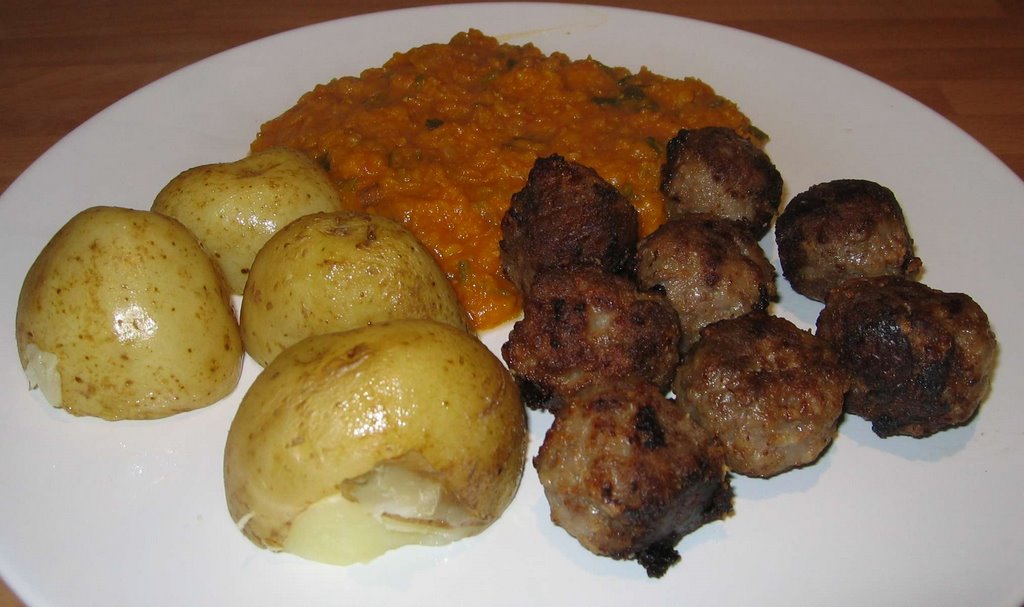
The meatballs are a left over from a recipe from Madhur Jaffrey's book Indian Cookery, Kashmiri meatballs. To be honest, she seems to have toned down the amount of spices to the point of blandness. Generally when I try a new recipe, I tend to follow it exactly, unless there is an obvious mistake and these meatballs just weren't what I expected. More spices next time, at least the double amount. But the mix was quite OK, after having been frozen for several months.
She recommended a lentil curry, which was even more bland than the meatballs. So this time, I tried the lentil curry from Mridula Baljekar's book Fat Free Indian Cookery (now sadly out of print). This one called for equal parts of red and green lentils. I only had red, so I used only them. Lundulph really liked it. When I tried it, it tasted almost exactly like my pumpkin cream. So I was surprised to say the least. Also I didn't like it much, because of that - I associate the flavour with dessert, not main course. Oh, well. Next time I'll try with green lentils too.

Finally, I boiled potatoes and sautéd them.

This is what it looked like.


I've become friends with butter again. Quite interesting, and oh so tasty.

19 December 2006

Omelette

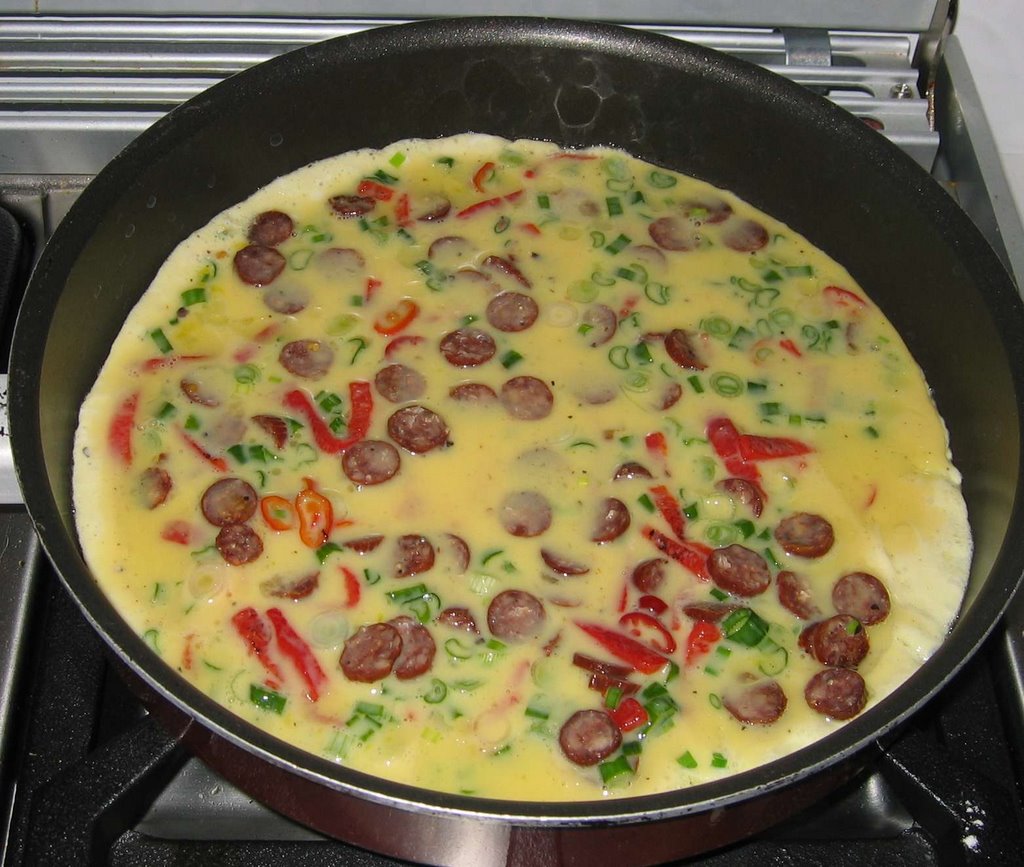
Lundulph and I have been chiseling away at our new kitchen work surface where the sink is to be installed, so absolutely no time for extravagant cooking of any kind. We've been having salads for lunch and tonight I thought it would be nice with some hot food, so I made an omelette.


Ingredients

1 tbsp grape seed oil
2 eggs
½ roasted or fresh pepper
2 slices of ham or salami
2 spring onions
3-4 mushrooms
1 pickled hot chili (optional)
1 dl milk
salt, pepper
grated cheese

Method
  1. Cut the pepper, meat, onions, mushrooms and chili into thin pieces or strips.
  2. Whisk them together with the eggs and the milk and season. If you are using salty salami, don't use salt.
  3. Heat up the oil in a pan, on medium heat.
  4. Pour the egg mix into the pan and leave to sizzle for 2 - 3 minutes. Then stir. It'll turn into a sort of scrambled eggs with bits in them, so not really food for entertaining guests.
  5. Add the grated cheese shortly before serving, so that it melts a bit.
  6. It should be possible to get it nice like they do in restaurants, but I've forgotten how to do that. Maybe cook on lower heat and leave for longer.
Last night I forgot the mushrooms and used a pack of dried moose sausage, which we picked up at the IKEA Swedish Food shop, when we went there last. Mostly they contain salt and fat, but Lundulph thought it was very tasty. I think pepperoni or chorizo would be good in the omelette too. Also Lundulph doesn't eat cheese, so I didn't put any either.

A quick search on the internet came up with this description on how to make the perfect omelette, with pictures. I'll try it out and update the post.

17 December 2006

Third of Advent

Well, one more Sunday to go and it's Christmas. We're pushing to get the kitchen ready, so it looks like we won't do a Christmas tree this year. But I'm not budging on the Advent traditions, here is the third candle.


Today, Lundulph asked if we could de-sweaten the non-alcoholic mulled wine, so I mixed it with an equal part water. This definitely made it more drinkable. With that, we had saffron buns, they are very nice when heated up in the microwave. It's easy to eat one too many.

A New Stir Fry

As I mentioned, I'm in between jobs at the moment. One of the leaving gifts (and I got surprisingly many, that was nice) was a cook book.

So last I tried one out. Had to change it a bit, because I couldn't find all the ingredients, but it was rather tasty, so I'm adding my version here.

Pork and Noodle Pan Fry


Ingredients

4 tbsp grape seed oil
350 g broccoli, cut into small florets
300 g fresh thick egg noodles
7 - 8 spring onions
450 g pork medallions
100 g shiitake mushrooms
200 g Cantonese chow mein sauce
250 g bean sprouts
2 handfuls roasted and salted cashew nuts

Method
  1. Wash the broccoli, brush off any dirt from the mushrooms and cut if they are too large.
  2. Wash and cut the onions into 5 cm strips.
  3. Cut the pork into thin strips.
  4. Heat up the oil, add the broccoli and stir for a couple of minutes, until it softens a little.
  5. Add the pork strips and stir fry for another couple of minutes.
  6. Add the noodles and the sauce and stir them in.
  7. Add the mushrooms and onions, still stirring all the time.
  8. When the mushrooms have softened a bit, add the bean sprouts and cashew nuts.
  9. Ready.
The original sauce was supposed to be sweet and spicy, but I couldn't find that and so used the chow mein. But the amount was the same and I think too little, at least two jars are needed, possibly three. Also I forgot to add some crushed chillies to give it a bit of a kick.

But on the whole it was tasty, fresh and quick to make.

15 December 2006

The Day of St Lucia

On 13 December, Sweden celebrates St Lucia. Amongst other things, special saffron buns (lussekatter) are made.

And this is the story of how I discovered that there are different types of flour. The first time I made these in the UK, I used plain flour and so they didn't rise. They went into the bin and I made a second lot the next day, again with plain flour and again with the same result. I'd invited friends and treated them to these horrible things. They politely tried them, so many thanks for that. I binned the rest after they left and decided never to make these again, I'd lost it, it was as simple as that.

But then I found out about different types of flour and so this year I tried again. Needless to say there was much worry involved and I ended up adding too much flour which made them a bit dry and dense. They did rise very well, but I made another mistake too - I decorated them with raisins and egg after they'd proofed, which caused them to collapse.

Also a bit more sugar would have been better.

Ingredients

50 g fresh yeast (or corresponding amount quick dry yeast)
200 g unsalted butter
6 dl full milk
1 g saffron
1 tsp granulated sugar
2 dl caster sugar
1 dl glucose or light syrup
½ tsp salt
1000 g + 200 g strong white flour
raisins
1 egg yolk

Method
  1. Place the butter and milk in a saucepan and let the butter melt on low heat and warm up the milk to just above 37 degrees.
  2. In the mean time, grind the saffron with a teaspoon of granulated sugar with a pestle and mortar. Then add to the milk and butter and stir in well.
  3. If using fresh yeast, break it up and dissolve in the liquid - very important that it isn't too hot or the yeast will die.
  4. If using dried yeast, blend it well with the 1000 g of strong flour.
  5. Add the sugar and syrup to the liquid, then incorporate the 1000 g flour.
  6. If needed, add more flour to form a fairly soft dough, that just about doesn't stick to the fingers. This is where I made my first mistake of adding too much flour, making the dough hard and difficult to work. Hot tip: use a kitchen machine to mix the dough or you won't have strength enough to make the buns.
  7. Leave to rise until it doubles in size, so in a warm place and covered with a tea towel.
  8. Make the buns and place on a non-stick baking sheet. Add the raisins and brush with the whisked up yolk. Then leave to proof for about 30 minutes.
  9. Pre-heat the oven at 225 degrees C or gas mark 7, but turn it down to 200 degrees/gas mark 6 when you bake the first lot.
  10. Bake one sheet at a time in the lower middle of the oven for 10 - 15 minutes.
  11. Leave to cool on a rack. The buns can be frozen. This recipe yields about 30 buns. And they are particularly nice when they are warm.
I'm including some links to traditional bun shapes

Saffron buns 1
Saffron buns 2
Saffron advent candle holder

Today was my last day at work and as a leaving do, I made these for my colleagues yesterday, along with gingersnaps and Swedish non-alcoholic mulled wine (courtesy of IKEA). The buns didn't quite turn out too well and so I still have quite a lot of them. They weren't sweet enough but I thought this would off set the extreme sweetness of the mulled wine. The gingersnaps went down very well though. Also I've had a glimpse of what it may feel like when you retire and leave colleagues and good friends behind. But a new job is lurking behind the corner and possibly less time to cook. So twice as sad in a way.

If you don't have time for buns, you can make a large plait and cover it with pearl sugar or make a wreath by rolling the dough and spreading the filling from the cinnamon buns mixed with some finely chopped or ground hazelnuts. Then make it into a roll and snip through half of it with scissors. Then put the two ends together to form a circle and alternatively pull the cut bits to the outside or inside of the wreath.

10 December 2006

Second of Advent

Today we've had more mulled wine. Unfortunately as we're in the middle of installing our kitchen, I haven't had time to bake anything. This is not an ideal situation and I'll try to do something about it in the next few days.

In the mean time, the second candle is lit.


And Lundulph is almost half way through his Christmas calendar. I made it for him a couple of years ago. I'm working on mine, didn't make it this year, sadly.

6 December 2006

Sponge Cake Without Eggs

This is a recipe I haven't made since uni and I suspect originated during some difficult times. I haven't made it today, but it's for my good friend Simon.

Ingredients

butter or margarine
dessicated coconut
2 dl grapeseed oil
2 dl caster sugar
2 dl Greek yogurt
1 tsp bicarbonate of soda
4 dl plain flour
2 tbsp cocoa powder
1 tbsp vanilla essence
raisins and/or nuts (optional)

Method
  1. Butter a cake tin, then pour some dessicated coconut and shake it around to get it well covered. Remove excess coconut.
  2. Preheat the oven to 175 degrees C or gas mark 3.
  3. Mix the oil and sugar (and vanilla, if using a liquid variety).
  4. Separately, mix the flour, cocoa and vanilla (if using a dry variety).
  5. Now you need to work fast. Add the soda to the yogurt, it'll start expanding fairly fast, so stir it into the oil and sugar mixture.
  6. Then slowly add the dry ingredient mix and whisk until smooth.
  7. Add raisins and/or nuts.
  8. Pour into the cake tin and bake in the middle of the oven for 30-40 minutes. Test with e. g. a bamboo skewer, it's ready when the skewer comes out clean.
Update 9th December 2006: I had a chat with my Mum today, she said that her version of this recipe uses oil instead of butter or margarine. Sunflower or olive oil.

4 December 2006

Pork Chop Night

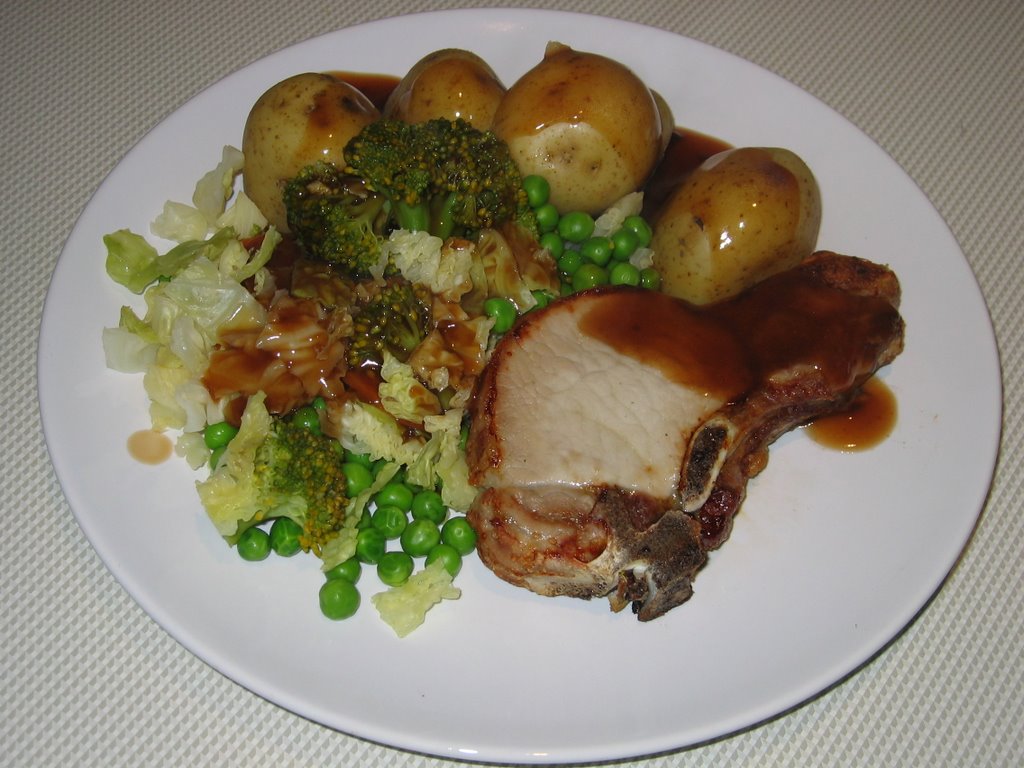
Well, finally I got around to making pork chops with potatoes, veggies and gravy. I got a couple of nice chops and grilled them according to the recommendation on the pack, 18 minutes, turning them a couple of times.

In the mean time, I steamed potatoes, carrots, broccoli, Savoy cabbage and peas.

I cheated and made Bisto beef gravy.

But all in all, it was absolutely yummy.

Next time I'll try it with Delia Smith's mashed potatoes. I think that would be better than just boiled potatoes.

And doing the vegetables sauté would be even nicer. For special occasions.

3 December 2006

First of Advent

The four Sundays before Christmas are celebrated as the Advent Sundays in Sweden, conveniently numbered first through fourth. This year is a bit unusual, as Christmas Eve is also fourth of Advent. The strangeness being that Christmas Eve is the main celebration day in Sweden with the big dinner and the opening of presents.

The tradition is that you have a special candle holder with four candles and on each of the Advent Sunday, you light a candle.


Also you drink mulled wine and eat ginger snaps. Swedish mulled wine is called "glögg" and is sweeter than the English variety. But the spices have different proportions and no fresh fruit is added, but dried slices of orange. The wine is heated, but not boiled, then served with raisins and blanched almonds. You pour the mulled wine in small glasses or mugs, then add a couple of teaspoons of raisins and almonds. You keep the spoon and eat the raisins and almonds while you drink the wine.

Today we're only having the mulled wine, I'm making ginger snaps later in the week. The Swedish mulled wine comes in bottles ready to heat. There are also bags with mulling spices in the shops, for the more enthusiastic people. Lundulph and I went to IKEA the other day and got some from there. There are non-alcoholic versions, wine based (both red and white) and brandy or vodka based. Since it's morning, we had the non-alcoholic one, which was very sweet.

One thing that is a bit strange to me is that in the UK blanched almonds are cheaper than regular ones. Well, I only had a pack of regular almonds, so I blanched them last night.

Place some water in a saucepan and bring to the boil. Put the almonds and leave to boil for a few minutes. Then take off the heat and leave to cool. The almonds can then be peeled by squeezing each at the wide end. Leave on kitchen roll to dry. After this you really wonder why the blanched almonds are cheaper.

29 November 2006

Royal Pickle

This is a traditional Bulgarian method of preserving vegetables for the Winter. Pickle in Bulgarian is "turshiya". This particular variety is called "tsarska" which means royal. It's super easy to make and is particularly tasty with the Bulgarian national brandy called "rakia".


Ingredients

Cauliflower
Carrots
Red peppers
Celery
salt, 20 g per 1 kg vegetables
granulated sugar, 40 g per 1 kg vegetables
Bay leaves, 1 per 1 kg vegetables
Crushed black pepper
Apple Cider vinegar, 2 dl per 1 kg vegetables + top up
Water

Method
  1. Wash all the vegetables. Break up or cut the cauliflower into small bunches, cut the peppers in largeish chunks and the carrots in slices, about 0.5 cm thick.
  2. Place all vegetables in a large bowl and sprinkle the salt and the sugar. Cover the bowl and give it a good shake to distribute the salt and sugar.
  3. Place in the fridge and leave for 24 h.
  4. Pour the liquid that the vegetables have released into a saucepan. Add 2 dl of apple cider vinegar for every 1 kg of vegetables and the bay leaves and pepper.
  5. Bring the liquid to the boil, then take off the heat and let cool completely.
  6. In the mean time, put the vegetables in jars.
  7. When the marinade has cooled, remove the bay leaves and distribute it between the jars. Generally it won't be enough to cover the vegetables, so top up with equal parts of apple cider vinegar and water.
  8. Close the jars and place in a cool place for at least 3 days, after that it's ready to eat.
This is a very tasty snack or a good nibble with rakia. Because the vegetables are not cooked, they remain crunchy.

Lundulph (and my Dad, I found out) is very partial to the cauliflower, so this year, I'm making one large jar with only cauliflower. Also he suggested I put some baby corn in as well. The reason I made the turshiya last year was because I had some left over green tomatoes that I didn't want to throw away, so if you grow your own tomatoes, this is a nice way to use them.
Generally I skip the celery, as I don't like it, but will try some next time.

Update 2nd December 2006:
The turshiya is ready, we've had some with rakia we bought last Summer. The baby corn worked very well and tasted very nice. Also, because I put together the juices from the cauliflower bowl and the mixed vegetable bowl when I cooked it with the spices, the cauliflower from both jars tastes the same.

The rakia was interesting - we visited a monastery in the town where we were staying and there was a strange man selling wine and rakia with monastery labels. We bought a bottle, and this is the one we tried today, surprisingly tasty. It has a twig of what I think is lavender and it tastes very flowery. Neither of us is blind yet.

Update 6th December 2013:
Going through my paper recipes, I notice that I've jotted down a couple of things on the paper version of this blog entry.
One kilogram of vegetables gives approximately 2 dl of liquid. It also fits nicely into two 1 litre jars. To top-up, use 2.5 dl of cider vinegar and 2.5 dl of water.

26 November 2006

Arunachal Fish Curry

I haven't cooked this for a very long time, but I found a couple of salmon fillets in the freezer, so I thought it would be nice for a Sunday dinner.

The recipe is from Mridula Baljekar's Fat Free Indian Cookery. Lundulph heard about this on the radio and downloaded the recipe from the Beeb. Sadly no longer available there.

I was quite skeptical, since I don't like fish and such much, but salmon is an exception, so I cooked it and let me tell you: the curry is fantastic! We bought the book immediately after that, the other recipes are fabulous too, so full of flavour and yes, definitely no added fat.

The difference is that I tend to double the amounts for the sauces, because I like to dip.

And in the case of this curry in particular, I'm using salmon fillets rather than steaks.

Also, Mridula Baljekar explains in the book about different spices and different pastes and purees that can be made in advance. Since we got the book, I've increased my spice collection to include about 30 little jars - almost the entire list of the book. And I keep ginger puree, boiled and browned onion purees in the freezer too, so making the tasty curries is very quick.

Photo will soon follow.