Showing posts with label ChristmasBird. Show all posts

23 December 2014

Christmas (Bird) 2014

IMG_4501

After various discussions with Lundulph, we've decided to stop our project to have different birds for Christmas each year. It's not sustainable, so we've settled onto goose. As before, I ordered the smallest possible goose from our butchers and went for the Mary Berry recipe I used a couple of years ago.

I did make a change this year - I baked the mushrooms, rather than fry with butter and also used single cream for them, rather than double cream. Still as tasty, but less fat on the whole.

IMG_4502

The new thing was the dessert - chocolate profiteroles decorated to look like Christmas puddings. I spotted this recipe in the queue at the till in the supermarket and as luck would have it, it was on their website as well.

Ingredients
Profiteroles
125 g plain flour
25 g cocoa powder
1 ml salt
300 ml water
2 tsp caster sugar
100 g unsalted butter
3 large eggs

Filling
300 ml whipping cream
2 tbsp icing sugar
1 tbsp dark rum

Decorations
50 g green fondant icing
15 g red fondant icing
200 g Belgian white chocolate

Method

  1. Pre-heat the oven to 200 °C fan and line a couple of baking sheets with paper.
  2. Sift together the flour, cocoa and salt. Make sure to mix thoroughly.
  3. Gently heat up the water, caster sugar and butter. Once the butter has melted, bring the liquid to the boil and remove from the heat.
  4. Stir in the dry mixture, then return to the hob. Stir vigorously and "cook" for a few minutes, the dough should come off the sides.
  5. Remove from the hob and set aside for 5 minutes.
  6. Lightly whisk the eggs together, then stir into the dough, a little at a time to get a glossy, pliable dough.
  7. Transfer the dough to a piping bag with a wide round nozzle, about 1.4 cm diameter.
  8. Pipe 24 blobs onto the baking sheets. Wet your hands and form each blob to a ball.
  9. Bake the profiteroles for 25 minutes, then take out of the oven and pierce a hole at the bottom of each, placing upside-down onto the tray.
  10. Return to the oven and bake for a further 10 minutes to allow them to dry out inside. Remove and transfer to cool on a wire rack.
  11. Place the whipping cream, icing sugar and rum into a bowl and whip the mixture to stiff peaks.
  12. Transfer to a piping bag with a narrow round nozzle and once cooled down, fill each profiterole from the hole in the bottom, then place them in the fridge.
  13. Roll out the green fondant icing to about 2 - 3 mm thickness and cut out tiny holly leaves.
  14. Pinch out tiny pieces of the red fondant icing and form to "berries", about the size of pin heads.
  15. Melt the white chocolate in a bain marie or in the microwave, taking care not to burn it.
  16. Transfer the melted chocolate to a piping bag with a small round nozzle, then drizzle a daisy over each profiterole.
  17. Place a couple of icing holly leaves and 3 red icing berries on each. Store the mini Christmas pudding profiteroles in the fridge.

I haven't made profiteroles for a while and certainly not ones with cocoa powder in them. So I wasn't entirely sure what would happen. It felt like they didn't quite puff up as much as regular ones. I'd also not baked ones where I made holes in the bottoms and continued baking to dry them out, though I know Mary Berry recommends this technique. What I got was some dark brown profiteroles, which weren't too puffed up and seemed pretty dry.

I also made the fondant icing decorations a day before as I didn't have the right cutter. I regret not buying one, it would have made life a bit easier.

IMG_4499

However, it is not impossible. I rolled out my icing and cut a large circle with one of my cookie cutters. Then I used one edge of another cutter shaped like the digit "3" to get a sort of oval shape. Continuing with the "3" cutter, I cut out the little bits all round the edge to make the oval look like a holly leaf. I should have made 48, but once I reached 30, I gave up as Lundulph came home and wanted dinner.

I assembled the profiteroles while the goose was baking, so the kitchen was pretty hot and I had to make sure to keep the cream as cold as possible. I recommend this on the day before as well.

Because the profiteroles didn't puff up, there wasn't room for much cream either and Lundulph and I had to have some extra cream on the side as the profiteroles were pretty dry and tasteless on the whole. More sugar is definitely needed, both in the dough and the cream, I'd say. So although they were quite pretty, they didn't taste very nice. Maybe I should try making regular profiteroles and dip them in chocolate, rather than use cocoa. Still, it was a nifty idea and Lundulph was happy, as he's quite keen on profiteroles.

The goose on the other hand did. I didn't prick the skin when I first put it in the oven, so after about 30 minutes when it was time to turn it round onto its back, it had puffed up and looked like it'd explode. So as I turned it over, I punched holes in the skin all over and the fat oozed out at speed. What we ended up with eventually was a goose where the meat came off the bone and there was no need for carving at all. The texture was very good.

I also splashed out on tender stem broccoli, which was really tasty too, I must remember that for next time.

And so we had a rather successful Christmas dinner, the two of us, and this year's main thing was that we finally got to eat it in our dining room on our brand new dining table. After all these years, we are now at the point where we can use all the rooms of the house, having always had one room being in a state of renovation and crammed with building materials. But no more. Well, not much anyway.

Merry Christmas Everyone!

15 December 2013

Bird of 2013

After racking my brains for some time, I announced to Lundulph that this year's bird would be a mallard.

This year I didn't bother with filling out the butcher's order form. As I found out last year, the form is so that they can make sure to have the right number of turkeys/geese for Christmas Day. But since we generally do our Christmas Dinner a week early, there's no risk of not being able to get hold of what we need.

With recent cooking success in mind, I wandered into the High Street and the butcher's and politely asked if they could secure me a mallard. I was well surprised when the chap serving me said they had one in the freezer and warned me that it would be a small one. I thought, it's just for me and Lundulph, it'd do, but when I saw it, I thought that's a pigeon and said, that perhaps I'd need a second one as well. So out came a second frozen thing. I paid and went home.

IMG_3693

This was on Tuesday, so into the freezer they went. I put them in the fridge on Thursday evening so that they could defrost slowly. I showed them proudly to Lundulph. He was also surprised that they were so small and wondered why there were no labels on them. This should have been my first alarm bell and it should have rung in the shop already.

Anyway, Saturday morning came and I got started on my preparations. On the whole I was doing some carbs, some proteins, some fungi and some greens, all fairly easy, but also all to be done more or less last minute before serving.

Again I'd done some research on duck and mallard recipes and was very annoyed that most of them seemed to involve fruits. Now after our initial disappointment with goose and prunes all those years ago, both Lundulph and I are highly suspicious of this - after all we're making a main course here, not a fruit salad. So I settled on a small paragraph in Larousse Gastronomique (2001) - season and roast.

When I opened the packages, both birds released quite a lot of blood, so I rinsed them under the tap and managed to get a heart and a throat out from one of them. The other one had had both wings and legs brutally torn off. And it was at this point I noticed that one of the birds had quite a pungent smell about it. Now, the book said, of all the wild ducks, mallard is the best and it should be cooked and eaten fresh, unlike a lot of other birds, which need to be hung for a while.

IMG_3694

Here, I should have taken the executive decision to just throw away the smelly bird, but unfortunately I didn't. Instead I pre-heated the oven to 220 °C, placed a wire rack in a pan with a lip, seasoned the two birds as best I could and placed them on the rack and into the oven. Now even if wild ducks aren't as fatty as farmed tame ducks, they still have quite a lot of fat on them, so using a roasting pan which will be able to contain the fat as it melts and drips down is crucial. And of course the wire rack inset, to keep the birds away from the fat. Of course cooking the smelly bird resulted in an even more pronounced unpleasant smell.

IMG_3698

The Larousse Gastronomique talked about a mallard of about 1.25 kg weight and stated that roasting for 35 minutes would do. I'd weighed both my birds and they were just over 600 g each. At this point Lundulph expressed some doubts as to whether we'd really got mallards or something else. I decided that I'd roast the birds for 15 minutes on their backs and a further 15 minutes on their fronts. Of course by this point it was quite obvious that they'd dried out substantially, but I just plodded on with other things and left the birds at the bottom of the oven, covered with aluminium foil to keep them warm - this probably made them even drier.

The next thing I made was Duchess Potatoes - it was right before the article on duck in Larousse Gastronomique, and I've made several attempts in the past at working out the secret behind these, without success. This time, it worked and I took the liberty of "improving" the recipe.

Duchess Potatoes Ingredients 500 g peeled potatoes
50 g butter
salt and pepper
a little grated nutmeg
1 egg + 2 yolks
2 tbsp finely cut chives

Method

  1. Cut the potatoes in thick slices and boil in salty water.
  2. Drain well, then put the saucepan back on the hob on low heat and mash up the potatoes finely or push through a potato press, then stir to dry out for a couple of minutes.
  3. Stir in the butter, the spices and the eggs and keep stirring for a few more minutes.
  4. Transfer the mixture to a piping bag with a star tip. Lightly grease a baking tray, then pipe rosettes of the mixture. It's easier to pipe while it's hot.
    IMG_3695
  5. Bake under the grill until the surface of the rosettes had dried out and turned golden in colour.
    IMG_3697

Next I found some inspiration from Anne's Food blog for Cognac-creamed funnel chanterelles (yellow foot) mushrooms. I have small portions of these mushrooms, parboiled and in the freezer. Oddly enough, I was only able to find one of these packets and I didn't fancy emptying the freezer to search for more, so I bought a large punnet of chestnut mushrooms, which I peeled and parboiled. This way I ended up with a lot more than the 250 g Anne mentions and used about 50 g butter and 1 dl French brandy for the frying, then 1.5 dl of whipping cream. They tasted quite nice and Lundulph declared that this is the only way he wants his funnel chanterelles cooked in the future.

IMG_3699

Finally for greens, I picked out a card from Ye Olde Recipe Collection, "Heston's Warm lettuce, peas & beans salad", which is from June 2012 and no longer listed among Waitrose's recipe collection. I did intend to follow the recipe since it required making an emulsion from beurre noisette, but I just wanted to get things ready for our Christmas Dinner and made it up as I went along. It turned out quite all right anyway.

Ingredients
100 g beurre noisette
500 ml chicken stock (not concentrate)
300 g frozen broad beans
200 g frozen garden peas
2 Romaine lettuces
salt and pepper
60 g pickled onions

Method

  1. Place the beurre noisette in a large saucepan on low heat to melt.
  2. In another large saucepan, bring the chicken stock to the boil, then add the frozen broad beans and garden peas and let simmer for a few minutes.
  3. Cut off the stalk of the Romaine lettuces, then take off the larger leaves, wash and shake off excess water.
  4. Add the lettuce leaves to the boiling chicken stock for a minute or so, then using a slotted spoon or tongs, remove along with the beans and peas and place in the saucepan with the beurre noisette and stir everything around to get it well coated with the butter.
  5. Serve immediately.
IMG_3696

This salad turned out to be very tasty. Lundulph guessed that the leaves were pak choi and in hindsight, this would have worked better. Lettuce is too delicate to heat up and a few of the leaves went brownish while I was making the salad and the ones that didn't went brown when I re-heated them a couple of days later. The original recipe states that 200 g of beurre noisette should be melted together with 80 ml of chicken stock. Then once the butter has melted, it should be blitzed with a hand-held blender to form an emulsion into which the vegetables should be stirred in. It seemed insane to use this much butter, even it it is lightened up by turning it into "mayonnaise", but I might give it a try as an alternative salad dressing or a dip perhaps.

Christmas Dinner table

So, we were finally ready for our Christmas Dinner. At this point I couldn't stand the stench of the rancid bird and threw it in the food bin. One bird would have to do us. But it was so dry, it was hard to carve.

IMG_3700

Lundulph also started theorising that this might have been a pheasant and not a mallard. I wasn't able to find out anything useful on the internet either. So we ate some bird-based meat and the bird of 2013 is a

???

On the whole the meal was good, if only I'd managed to get better birds and not roasted them into oblivion...

And finally, once again all the lead shots ended up with Lundulph. We found 6 - 7 of them.

IMG_3701

Lundulph has started campaigning to stick to goose from next year onwards, since we get at least one turkey around the festive time, depending on where we celebrate Christmas - see in the UK most people have turkey for Christmas, but in my Bulgarian family, turkey is eaten at New Year. So a goose is a good and sustainable choice. I personally would be happy to roast a chicken one year, simply because we never do this anyway, but it's not festive enough for Lundulph. We'll see next year, when the time comes.

24 December 2012

Bird of 2012

After missing two years in a row, Lundulph and I decided to restart our Christmas theme by going back to where it first started - with goose. We did this a few years before I started blogging and in fact was when we got the idea of doing a different bird each year too.

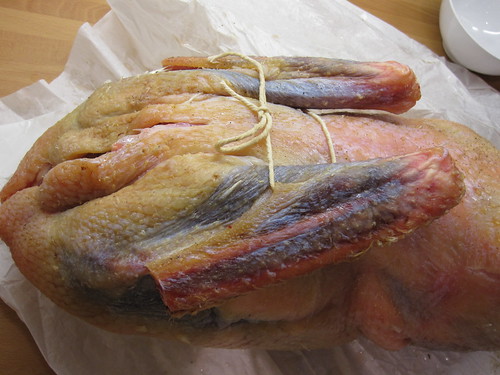
Thus, when the order forms came up at our local butcher's, I got one straight away. And last Wednesday I went to pick up my goose. Quite a difference to the previous time, when I bought it from the supermarket and it was frozen. What I got on pick-up day was this:

IMG_1922

Quite fancy, a free range fresh goose, traditionally raised and yadda yadda. And it came with extra goose fat for the tatties and some giblets for the stock and a recipe leaflet.

But I'd already settled on a recipe from Mary Berry and went off to buy the necessary ingredients (while my sourdough breads were rising/proofing).

So first I made the stock as per Mary Berry's recipe, though I couldn't get hold of celery, so I skipped that and also parsley stalks - I just used about a dl of my frozen chopped parsley instead. After an hour, I had a dirty cooker and a pot of stock. I suppose I could have tried to do something with the giblets, but I couldn't be bothered and discarded them. I then strained the stock and let it cool down before putting in the fridge.

I also peeled two punnets (250 g each) of chestnut mushrooms, only separating the caps and the stems, no chopping or dicing.

The following day was the day of the dinner, so I started with peeling and preparing the potatoes for Hasselback-style roasting.

IMG_6081

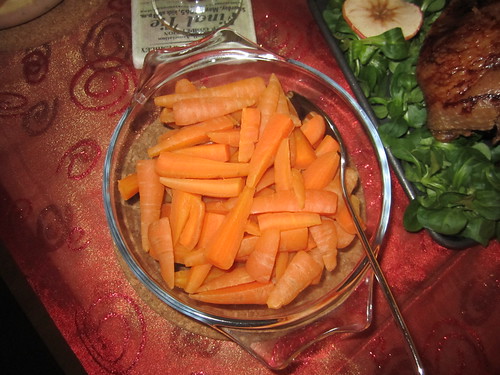
Then I cut a large head of cauliflower into bite-size florets and the Chantenay carrots into thin strips. I originally wanted what is called baby carrots in Sweden. These are tiny carrots, no more than 3 cm long and very flavourful. But I wasn't able to find any, so had to settle for Chantenay.

I then spent some time faffing around to work out how to roast the goose - I have a large and deep roasting tin, but it doesn't have a rack. I also have a rack, but that doesn't fit in the oven. I ended up using the rack from my grill pan in the deep large pan. Once this was sorted, I rinsed the goose and set about tying the goose up. See the previous time we did this, we had purchased a frozen goose and when it was thawed, it was still stuck in a sort of foetal position, so we didn't bother tying it up and so during roasting it stretched out and wedged itself into the oven. I had no intention of fighting with a roast goose that refuses to get out of the oven.

Thus, wings behind the back

IMG_1926

Then the filling went into the main body cavity - peel from one apple ("Pink Lady" which Lundulph likes to eat), peel from a lemon and a few leaves of sage.

IMG_1925

Bottom pinned together and legs together. I probably should invest in a thick needle to sew things together.

IMG_1927

The goose went "face down" into the oven and had to go in diagonally, it was so big. 30 minutes later, there was a decent layer of fat in the roasting tin already and the back of the bird had started crisping up rather nicely. I turned the goose around on its back and let it roast for a further 20 minutes as per the instructions and then turned down to 180 degrees.

After the initial 50 minutes, I'd laid out the potatoes in another deep roasting tin and now just drained much of the fat from the goose onto the potatoes. I used a brush to make sure they got well coated and I put them to roast as well, they would need about 1 h and 15 minutes, and the goose would need 1 h and 30 minutes, so it would work out OK.

I then focused on the veggies. I first fried the mushrooms in a little butter and a bit of salt until they went soft and had a little colour. I then poured 300 ml of whipping cream and added a couple of bruised sage leaves along with more salt and some ground black pepper. I just brought the cream to simmer, then I transferred it to an oven safe dish with a lid and put under the goose to keep warm.

IMG_6085

Next I steamed the carrots and cauliflower in separate pots. I kept an eye on the cauliflower, I wanted it to keep some crunch. In a saucepan, I heated up 300 ml double cream, seasoned with salt and pepper and pressed in a clove of garlic. Once it started simmering, I added the cauliflower and stirred it around, then transferred to another oven safe dish with a lid and put in the oven as well.

IMG_6088

The carrots were to remain steamed only and I also steamed some frozen peas. I didn't even put a knob of butter on top of them - pure health in all the other rich food.

IMG_6087

Once the goose was out of the oven and covered in aluminium foil and resting, I made the gravy. At this point I couldn't work out how much of the stuff in the large deep pan was cooking juices and how much was pure fat, so I just took a little from it and used all of the stock I had prepared before, I think it was around 800 ml, but I'm not sure. Because if this I didn't really weight the amount of flour, just put in 2 tbsp and stirred it in. It thickened a little once it came to the boil and that was it. As gravy goes, I didn't notice too much flavour in it, so perhaps regular chicken gravy would have worked as well. And so we were ready to enjoy our Christmas Dinner.

IMG_6083

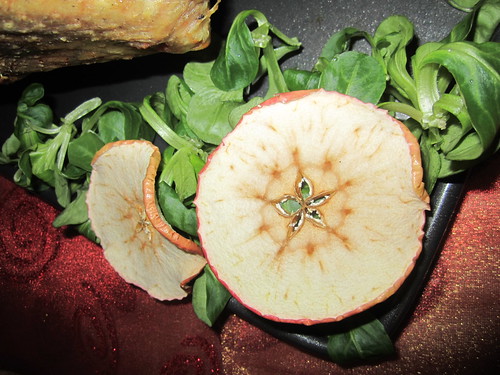
I did take the time to dress the goose for serving. Nothing elaborate - a packet of lambs' lettuce and a couple of thin slices of apple, which I'd dried in the oven at about 150 degrees, turning regularly. This was more of a fun whim, rather than anything else.

IMG_6093

Everything was so tasty, Lundulph had a huge second portion and I never got time to make dessert and to be honest, we didn't have space for it either. I was going to do it on the following day, sadly this was not to be as I got a bad case of a stiff neck and spent the following days mostly sitting very still, propped up with pillows. Lundulph says I need to exercise more and I suspect he is right. We both will, as soon as the festivities are over...

Mary Berry's recipe is really good and very simple and crisped up the goose beyond my wildest expectations. It's a shame I didn't take the time to clean it up from the odd feather stubs, it would probably have been quite tasty. I think this recipe would work nicely with duck as well. I might swap the sage for rosemary, I like the taste better.

And as I finished clearing the table, I realised that I'd forgotten the Christmas crackers. Oh well, never mind.

25 December 2010

I'll Have A Blue Christmas...

...without Lundulph.

Sadly due to the severe weather that has been raging all over Europe, Lundulph was unable to join me in Stockholm for the Christmas holidays, instead we're each celebrating with our respective families.

Thus the lack of a new Christmas Bird with all the trimmings.

We aim to try and catch up over New Year next week, but it won't be quite the same and so this year's well-laid plans are pushed on to next year.

22 December 2009

Bird of 2009

Well, once again it's close to the end of the year, with Christmas in a couple of days and time for Lundulph and I to have our private romantic Christmas Dinner. This year's bird is

Ostrich

IMG_0377


A few weeks back, I started googling for ostrich meat. Our local butchers could only do steaks, but the internet revealed that there are more possibilities, one of them being a roast. And so I found a farm up in Lincolnshire called White House Farm. They do a variety of cuts and offer the possibility of paying via paypal which I found very appealing. On the day I placed my order, paypal had done something to their interface, which didn't accept my password and the lady at White House Farm very kindly called me and let me know that the purchase hadn't gone through. Not to mention that I had managed to generate two identical purchases. In fact, I ended up having to change the paypal password. Shame on you programmers and testers on not picking this one up!

But the next day my order went through. The ostrich was to be delivered on the 18th December. As many UK residents will know, it snowed on the 17th and I was worried that my order wouldn't be delivered, so I called them and again the very helpful lady I spoke with confirmed that my roast had gone out and should arrive on time. And it did, shortly after lunch, packed in a polystyrene box and taped to an ice pack. Very impressive. And I got a few tips on how to cook it too. It was pricey, though, £26 per kg. I bought their largest fillet roast which was 600 g and went for £15.60, but I think Christmas is only once a year and it's a festive occasion which is worth spending some extra money to make extra special. The fillet steak looked so tiny, once I put it in the fridge though.

Spices and meat

The recipe I'd chosen was the simplest possible - the fillet roast coated in a mixture of spices and I found it on recipezaar. I also made the suggested sauce, which sadly was missing the unit for the amount of water, so I made a guess it should have been a cup. To be on the safe side, I'm writing both up below.

To accompany this special piece of meat, I chose potatoes, Savoy cabbage and mushrooms.

Ready to go in the oven

Roast Ingredients
2 tsp coriander seeds
2 tsp black pepper corns
2 tsp juniper berries
1 tsp cardamom seeds
3 cloves garlic
600 g ostrich fillet roast
3 tbsp grapeseed oil

Roast Method
  1. The spice seeds need to be ground. Recipezaar recommended mortar and pestle or blender. I decided to try the mortar and pestle and 30 minutes of work resulted in rather tired hands and squashed juniper berries, but nothing further. I transferred the mixture to my blender, which after about 5 minutes on high speed reached "cracked" stage, but I thought it should be finer still, so I ended up putting the whole lot through my coffee grinder (also manual!). I recommend doing this on the day before, while watching TV.

  2. Pre-heat the oven to 200 degrees C (gas mark 5).

  3. About 2 h before roasting, pat the fillet roast dry, then rub in the spice mixture along with the pressed garlic. After rubbing, I placed it in a bag, tied securely and rubbed it several times during the 2 h of standing.

  4. When the 2 h are up, heat up the grapeseed oil and brown the ostrich roast on all sides. Be careful as this is extremely lean meat, about 30 - 45 seconds on each side on medium high is enough. Then transfer to an oven safe dish.

  5. Bake in the middle of the oven for 15 minutes, then take out and check the middle by cutting into it. If it seems too pink, give it another 5 minutes, the check again. For me it seemed still a bit too red, so I gave it another 15 minutes at gas mark 3 which corresponded to 150 degrees. It seems that ostrich meat can be eaten rare to medium rare, like beef. I went for medium rare and after it had baked, I let it rest for some 10 minutes. The roasting will vary with the size of the fillet - mine was long and fairly thin, but if it's thicker, it might need longer. Thus keep checking by cutting into it.


Resting

Cream Mushrooms Ingredients
250 g fresh chestnut mushrooms
salt to taste
1 tbsp butter
1 dl double cream

Medium rare

Cream Mushrooms Method
  1. Peel the mushrooms and cut off the edge of the stem if it looks dry, but keep intact for visual impact.

  2. After browning the ostrich meat, add a bit more grapeseed oil to it if needed, then fry the whole mushrooms for a few minutes, stirring so they pick up the flavours from the meat. Add the salt to help release the juices.

  3. Transfer to the oven safe dish with the ostrich and bake together. I recommend making sure the mushrooms are placed so that they stand on their stems, that way whatever juices they release, it'll run to the bottom of the dish, rather than stay contained in the mushroom cups.

  4. When the meat is ready and out of the oven. Heat up the butter in a frying pan on medium heat, then add the mushrooms and the cream and stir around for a few minutes so they take up the flavour. Transfer to a serving dish and keep warm until serving, if needed.


Mushrooms

Gravy Ingredients
2.5 dl red Merlot wine
0.5 dl port wine
3 tbsp cranberry sauce
1.25 dl water
2 Oxo beef cubes
2 tbsp fine balsamic vinegar
the liquid from the ostrich roast and the mushrooms.
1 tbsp butter
1 tbsp Bisto beef gravy granules


    Gravy Method
    1. Put together all ingredients except the juices from the meat/mushrooms, butter and gravy granules, into a sauce pan and bring to the boil, stirring occasionally. Reduce to about half the original size, then set aside until the meat is ready.

    2. When the ostrich and mushrooms have baked, pour the liquid into the gravy sauce pan and just before serving, bring it to the boil, then add the butter.

    3. Once the butter has melted, add the gravy granules and continue to simmer for a few more minutes until they have dissolved.


    Spicy Savoy Cabbage and Peas Ingredients

    350 g Savoy cabbage
    3 tbsp grapeseed oil
    3 tbsp finely grated fresh ginger
    1 tsp hot chilli powder
    1 tsp turmeric
    2 dl frozen peas
    2 tbsp water if needed

    Spicy Cabbage

    Spicy Savoy Cabbage and Peas Method
    1. Shred the Savoy cabbage.

    2. Heat up the grapeseed oil in a deep-ish saucepan on medium and add the cabbage, stirring vigorously to prevent it from burning.

    3. Add the ginger, chilli and turmeric and keep stirring to get it well blended.

    4. After frying for a few minutes, add the peas and fry for 3 - 4 minutes more. If it seems too dry, add water and keep stirring.

    5. Transfer to a serving dish and keep warm until serving.


    The potatoes are my usual Hasselback style, but with goose fat, instead of grapeseed oil. Using a different oil didn't result in a big difference, like when doing regular roast potatoes, oddly enough. I only buy goose fat for the Christmas roast potatoes, so didn't want to drop this tradition.

    Hasselback potatoes

    Et voilà, le tout ensemble:

    Fully laden plate

    As a starter we had Veuve Clicquot But with a wild hibiscus flower to accompany our salad made of 500 g grated carrots, 500 g grated mooli and 1 dl sesame seeds. There was quite a bit left over. This is a fairly traditional Bulgarian Winter salad, no extremes in flavour, just juicy and crunchy. We dressed it with rice vinegar and toasted sesame oil, both of which were a bit overpowering, so will probably skip them next time.

    For dessert, I went for the lovely Margarita ice cream from Nigella Lawson. We had this a couple of weeks ago at our friends' Stephen and Kerry of Dinnerdiary. I don't really like Nigella, not sure why exactly and catching glimpses of her Nigella Express show, put me off food for some time, but this recipe is really good and very easy.

    Margarita ice cream

    I made an alteration of course, I added 150 g dessicated coconut and it worked a treat! For serving I used chocolate cups and I dusted the plate with coconut flavoured cocoa powder from Whittard of Chelsea. Regular drinking chocolate cocoa powder.

    Round up:

    It was wonderful. All of it, Possibly best Christmas dinner since we started these in 2002.

    Lundulph concurs by saying "It was right tasty!".

    Of course, spending about an hour before lunch watching the birds in our back garden helped - it had snowed overnight again, but it was sunny and we counted 27 different birds! The special treat being the bullfinches and blackcaps - both males and females!

    In particular the ostrich was great - no gritty bits, just pure muscle meat and I was lucky to get it just right. The texture was great, the pepperiness of the spices combined perfectly with the sweetness of the gravy and the heat of the cabbage meant the whole meal felt hot throughout. This is a thing with Lundulph, he likes his food piping hot and sadly even pre-warming our plates doesn't make much difference, they cool down pretty quickly. The chilli powder provided the spicy heat to give the impression of temperature heat. Brilliant!

    It was hard to resist having seconds, but I managed just. After all there was dessert coming.

    I'm definitely going to cook ostrich again, it may well be the perfect meat for me. I've always been fussy when it comes to meat and generally I need to see the meat in order to decide if I'll eat it or not and grisly and crunchy bits are a big no. I can't even force them down. But the ostrich fillet roast was completely free from these.

    Merry Christmas Everyone!

    13 December 2008

    Bird of 2008

    IMG_4099

    Note the fairly small print - may contain shot. I found one while chopping them up and Lundulph found several during our dinner, possibly ate a few too. I bought 4 birds that were quite a bit smaller than I expected, comparing to the ones hanging around in our garden.

    The recipe I decided to go for, after a fairly short research session was this one. Breast of wood pigeon with sweet potato rösti, buttered Savoy cabbage and red wine sauce. Quite a mouthful. It seemed fairly simple to do though and I didn't want to end up tired after a whole day's cooking.

    I increased the amounts to what I thought would be 4 portions:

    Ingredients

    1 large sweet potato
    4 tbsp olive oil
    salt and pepper

    1 small Savoy cabbage
    3 l water
    salt
    40 g butter
    10 sage leaves

    4 pigeon breasts
    3 tbsp olive oil

    2 tbsp olive oil
    3 cloves of garlic
    5 dl red wine
    3 bay leaves
    5 sprigs lemon thyme
    10 juniper berries
    salt and pepper

    Method
    1. If whole pigeons are used, wash and cut off the legs, wings and back and save for later. Pat the breasts dry with kitchen tissue.

    2. Peel and grate the sweet potato. Then place in a couple of layers of cheese cloth and squeeze out as much excess liquid. Do about a handful at a time, it's easier and gets more liquid out. Then mix with the olive oil, salt and pepper.

    3. Trim the outer leaves of the Savoy cabbage and wash. Cut in four and remove the stalks and shred it. Bring the water and salt to boil and put the shredded cabbage in and boil for 6-8 minutes, then drain.

    4. Place the sweet potato into an oven and hob proof pan and place on the hob on medium heat and fry for 6-8 minutes. Stir occasionally and add more olive oil, if it seems too dry. Pre-heat the oven to gas mark 6 (200 degrees C). Move the pan to the middle of the oven and continue to bake for another 15 minutes.

    5. Heat up the oil and brown the pigeon breasts, then put in a pan and continue baking in the oven.

    6. Add a bit more oil into the pan where the pigeons were browned, press in the garlic and fry for a couple of minutes, then add the remainder of the sauce ingredients and simmer to reduce to half the volume, then strain.

    7. Just before serving, heat up the butter. Then add the sage and fry for about a minute until they start to wilt, then add the cabbage and stir well.


    IMG_4100

    Now, I've had Rösti in Germany many years ago. It was made of regular potatoes, but I couldn't work out how it all stuck together - just grated potatoes. Same with the sweet potatoes, I couldn't get them to stick together and form a cake, so I gave up and stirred around, it had actually started to burn by the time I did this. Still it wasn't ruined, but turned out quite nice.

    The pigeons were interesting to chop up - the original recipe called for breast thinly sliced and should I try this recipe again, I'll definitely try to fillet off the breasts. I ended up over-doing them and they tasted mostly like liver with a bit more texture than actual liver. I should have baked them at lower temperature as well and I probably kept them too long for browning as well.

    The cabbage was nice, could have done with a bit more salt. The red wine sauce was very nice indeed. I think pigeon needs another chance, and less baking at lower temperature might give better results.

    But I now have a new obsession - work out how to make proper rösti.

    For dessert I made mille-feuille, also known as Napoleonbakelse in Sweden. Sadly I forgot to prepare the puff pastry and bought ready rolled one.

    I used one packet of puff pastry - 375 g and made the créme mousseline.

    Place the rolled out puff pastry on a baking sheet (line with parchment if necessary), prick with a fork, then place in the fridge for 30 minutes or so.

    Pre-heat the oven to gas mark 7, 220 degrees C, place a second baking sheet on top of the puff pastry and bake in the middle of the oven for 20 minutes. Then remove the top sheet, turn down the heat to gas mark 3, 170 degrees and bake for further 5 minutes. The second baking sheet prevents the puff pastry from rising high. Once done, take out and leave to cool.

    The cream I made turned out very runny, I should probably have put it in the fridge to make it stiffer.

    Trim the edges of the puff pastry if necessary, then cut up in strips, about 5 x 10 cm size. Select the flattest nicest looking ones for the top layer.

    Dust a plate with cocoa powder, place one puff pasty peace on top, spread some cream (or pipe), place a second puff pastry piece, then another layer of cream and finish with the nice piece of puff pastry.

    Dust with icing sugar. Each layer of cream should be at least 1 cm thick.

    IMG_4101

    Because the cream was so runny, everything squirted out and was mis-shapen. Generally in cafés, only one layer is proper créme mousseline, and the second layer is just whipped cream. This is always an annoyance with my Mum, it should be créme mousseline.

    Also, if the pastry keeps its shape once you start eating it, there's something dodgy with it - probably gelatine or something similar. The créme should just be squeezed out between the layers and go all messy on the plate. Which is why I generally don't buy these pastries in cafés, I can't eat them in a dignified way.

    22 December 2007

    Bird of 2007

    Ever since Lundulph and I moved together, we've had a different bird for our romantic Christmas dinner for two.

    Our first Christmas we had goose as per old English tradition. I bought a frozen one, it cost £20. Thawed it and followed Delia Smith's recipe, despite the gut feeling we both had that it wouldn't work - even after I'd managed to hunt down the Armagnac that was required. I made Lundulph do the actual stuffing, it seemed too iffy for me. We didn't tie the goose either - it stretched out in the oven and we struggled to get it out in the end. And from the rather big bird that we put in, what came out was more of a pigeon size - during the roasting we'd gathered up about 2.5 pints of goose fat.

    Don't remember much of what goose flesh tastes like. But the stuffing was a traumatic experience and since then I have severe doubts about Delia's capabilities as a cook. The only good thing that came out of this is discovering that goose fat is the ultimate thing for roast potatoes. Luckily Sainsbury's sell that in cans and I buy one every year for Christmas. And it's picking up in popularity too, it's easier to find these days.

    Over the years, we've had turkey as is tradition today, chicken and guinea fowl last year. And so I present the bird of 2007:

    Pheasant

    This is what we settled on last minute two weeks ago, after discussing other game birds and their status in the UK in terms of how threatened they are. It's also from my new thing of going to the butcher's. And it seems that pheasant is en vogue this year, they had loads. I also ordered a cured uncooked ham for Christmas Day.

    A quick search on pheasant recipes of the roasted type didn't result in anything inspiring, so I defaulted to look at Delia's website, where two recipes seemed interesting - "roast pheasant with chestnut stuffing and port and chestnut sauce" and "pheasant roasted in butter muslin". I couldn't decide on which of the two, so picked bits from both and invented as I went along.

    Ingredients

    1 small pheasant plucked and cleaned
    3 rashers of unsmoked streaky bacon
    1 fresh bay leaf
    3 sprigs fresh thyme
    salt and pepper
    1 knob of butter, about 20 g
    1 tsp plain flour for the roasting bag

    Stuffing

    3 shallots
    2 rashers of unsmoked streaky bacon
    10 g butter
    110 g roasted and peeled chestnuts, chopped
    1 handful of roasted and coarsely ground pine nuts
    75 g dried cranberries
    1 tbsp chopped fresh parsley
    2 tsp fresh thyme
    0.25 tsp ground mace
    salt and pepper
    2 fresh bay leaves


    Sauce

    juices from the pheasant
    2 tbsp plain flour
    2 dl sweet Madeira
    375 ml Oxo chicken stock
    90 g roasted and peeled chestnuts, quartered

    Method
    1. As Delia recommends, I wiped the bird with kitchen towels, also the cavity, there was some blood that came out, when I unwrapped the pheasant. Also it seemed to smell a bit funny, so I had some doubts.
    2. Then I gave it a good massage on the breast to loosen the skin, just like Fanny Cradock. This was a rather surreal experience, but I managed to slide my hand entirely under the skin in the end. So I stuffed the bacon rashes along the breast under the skin.
    3. For the stuffing, I peeled and diced the shallots, diced the bacon and fried them in the butter for a few minutes and left to cool.
    4. Once the shallots and bacon were cool, I added the chestnuts, pine nuts, cranberries, parsley and thyme and seasoned with salt and pepper and stirred well.
    5. Then I bruised the two bay leaves, but not too much so they'd come apart. I stuffed one in the cavity, then half filled with the stuffing mixture, then the second bay leaf, then as much stuffing as would go in. And to be on the safe side, I tied the legs and tail together.
    6. I then put a tsp of plain flour in my roasting bag and shook it about, this was recommended on the packaging.
    7. I placed the pheasant in the bag, seasoned with salt and pepper, placed a bay leaf and 3 sprigs of thyme on it, and a knob of butter on top, tied it in and put in the oven (preheated at gas mark 7 (220 degrees C) on the lowest shelf. I used a roasting tray for this, but without the grid.

    8. I had some stuffing left over, so I put it in a shallow oven safe dish and put it the oven as well.


    For the roast potatoes, I peeled and cut the potatoes in chunks, as they were quite big. Then I boiled them for 7-8 minutes, drained the water, and shook them around in the pot with the lid on. This rips up the surface of the potatoes and is the bit that'll soak up fat and become crispy, so it's a vital step. I put a deep roasting tin onto the hob (make sure it can take it!) and poured out most of the goose fat of the tin and heated up. Once it was hot, I transferred the potatoes to the tin and rolled them around to get them coated with fat, then put on the top shelf of my combined grill and oven. I've never had good experiences using it as an oven before, but on maximum 8 it did the trick. I took out the potatoes a couple of times during the roasting and basted with the goose fat and also turned them around a bit.

    1. I completely forgot to time the pheasant, I think it was in for about 40 minutes by the time I decided it was ready and took it out. I cut the top of the roasting bag and took out the bird, put the roasting grid back onto the roasting tray and put the bird on that and back in the oven to give it a bit more colour.
    2. I cut a small hole in one of the bottom corners of the roasting bag and poured out the juices into my non-stick wok pan and put it to boil.
    3. I put in one tbsp of plain flour and stirred in, then as soon as it got thick I added the Madeira. Sadly it went rather lumpy and mostly it stuck to the whisk, so I slowly added a second tbsp to make up for it.
    4. I added the stock, still stirring and wondering if I should sieve it or not. Decided against it in the end and added the chestnuts and left to simmer for a few minutes.
    In addition I also steamed Chantenay carrots and broccoli.

    All in all, I must say, it turned out rather well, the pheasant was very tasty, not at all extreme in any way, so I'm guessing it was a young bird. It wasn't dry either, thanks to all the bacon and the roasting bag. The cranberries were a bit too sweet, especially combined with the sweet Madeira sauce, but the flavours mixed rather well together.

    As accompaniment we had a Californian Zinfandel from 2005, which worked quite nicely.

    Due to all other things we still had to do, and general lack of imagination, I bought a ready made chilled dessert, which was very nice - some sort of chocolate pudding with gooey chocolate sauce and it came in small ceramic ramekins. I microwaved them to get the sauce bubbly and served with clotted cream ice cream. Yummy!

    Lundulph was so hungry, he tucked in before taking a photo.

    Right, now back to the kitchen to mix up some dough for the gingerbread house, that's tomorrow's project and this year the nieces have selected a new and complicated design.

    24 December 2006

    Fourth of Advent


    As it is on the same day as Christmas Eve, we decided to cheat a bit and light the fourth candle on the Saturday during our traditional Christmas dinner. This is the first of three that we are having, the next one is on the actual Christmas Day with Lundulph's family and then the third one is on New Year's Eve with mine.

    Since we moved together, we've been going through various birds for our special Christmas dinner and last year we had guinea fowl. But since we didn't have an oven to roast it in, we did guinea fowl au vin (from Delia Smith), which was nice, but not really Christmassy. This year, we repeated the guinea fowl, but according to another one of Delia's recipes, guinea fowl with 30 cloves of garlic. This sounds drastic to any one but a garlic lover, but to be honest, it was absolutely divine! The garlic cloves are cooked in their skins and that gives a very delicate flavour.


    With this, I did roast potatoes and carrots. Boiled the potatoes (Maris Piper) with the carrots for 10 minutes, removed the carrots, poured out the water and fluffed up the potatoes by shaking them in the saucepan. Then placing them on a deep baking sheet, where I'd heated up about 2 dl goose fat. I added the carrots as well, browned all a bit on all sides and put in the oven together with the guinea fowl. Took out and turned the potatoes after 20 minutes and also poured hot oil over everything again. At this point wafts of delicious smells of rosemary and garlic came out from the oven. Mmmmm!

    Also, I steamed some sprouts and broccoli. When they were done, I added them to the tin of potatoes and carrots, to get a bit of goose fat on them and back in the oven for another 5 minutes.

    Needless to say, this is a recipe I'll repeat, it was ever so tasty.


    With the bird, we had a Rioja from 2001, Baron de Ley. This is a wine we discovered when we went to Spain in 2003. It is a relatively new brewery, but the wines are very good.