Showing posts with label Austrian. Show all posts

18 April 2019

Osterpinze - Austrian Easter Bread

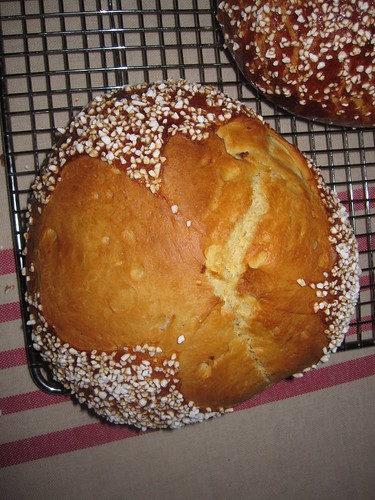
I have a lovely colleague, who is originally from Austria and last year she told me about the traditional Easter bread they have. She compared it to a brioche, but less sweet. Looking at photos it is clearly related to the Bulgarian kozunak, however, it seems it's eaten as a breakfast bread with savoury things like ham and hard-boiled eggs.

IMG_5761

So this year, I asked her about recipes she'd used and she sent me one she said was rather good. But then she also mentioned a version with white wine, and I was way too intrigued and asked for that recipe as well. It is here in German. I've lately started to refresh my German language skills in a more targeted way and this recipe adds the extra dimension of having several new words, so will be a learning experience as well.

Ingredients

Makes 6

250 ml white wine
2 tsp anise seeds
1 dl dark rum
1 dl raisins
250 g milk
140 g granulated sugar
2 x 7 g sachets quick yeast
1 kg strong white flour
2 large eggs
5 large egg yolks
6 g salt
zest from a large lemon
250 g soft unsalted butter
6 tsp nib sugar
1 egg for egg wash

Method

  1. Heat up the white wine and stir in the anise seeds, then set aside for 3 h, then sieve to remove the seeds.
  2. Heat up the rum and add the raisins, then set aside for 2 h.
  3. Sift the flour.
  4. In a large glass bowl make the poolish/pre-ferment: warm up the milk with 30 g of the sugar to about 30 °C and stir in the yeast until it's fully dissolved.
  5. Add 80 g of the flour and stir to get a batter. Cover and let stand for 20 minutes in a warm place. It should increase in size significantly, so make sure to use a large bowl.
  6. In the bowl of the dough mixing machine, whisk together the 2 large eggs, the egg yolks, salt, lemon zest and remaining sugar for about 5 minutes until it goes really pale and fluffy.
  7. Add the remaining flour, the poolish/pre-ferment, white wine, raisins along with the rum they were soaked in and mix to a soft dough.
  8. Check that the gluten has developed with the window pane test and then add the butter in chunks and get it well incorporated into the dough.
  9. Remove the mixing attachments from the dough, cover the bowl and leave to rise for an hour.
  10. Break the egg for the egg wash and whisk it to mix the yolk and white. Leave to stand and keep stirring every now and then.
  11. Turn out the dough, fold and turn it a few times, then let rise for a further hour.
  12. Line three baking sheets with baking paper and have the nib sugar ready in a small bowl along with the egg wash.
  13. Weigh the dough, then divide into 6 equal parts.
  14. Shape each into a round tight ball. Place two on each baking sheet on a diagonal, so that they don't stick together as they proof, and brush well with the egg wash and leave to proof for about 30 minutes.
  15. Pre-heat the oven to 170 °C.
  16. Just before baking each sheet, brush a second time with the egg wash, then sprinkle with nib sugar and using scissors, make three cuts centred in the middle.
  17. Bake each sheet for 30 minutes until the breads go golden brown.
  18. Remove from the oven and transfer to a wire rack to cool down completely.

I made these the day before Lundulph's family arrived for Easter. I served them to our guests as a mid-morning snack and they were wonderfully fluffy and disappeared alarmingly quickly. It was lighter than the kozunak and stayed soft surprisingly long - it was fine for breakfast 2 days after baking and only on day 3 did we need to whizz it in the microwave to restore the fluffiness and softness. I had intended to save one and give to my colleague as thanks for sharing this recipe, but to be honest, these breads were just way too tasty to want to share.

A note on the white wine - the recipe didn't really specify what to use, so I thought a dessert wine would be best and I bought a fancy muscat wine, Domaine Tailhades Muscat St Jean de Minervois. It was pricey and came in a half bottle and I had to hide it from Lundulph, who fancied using it as a dessert wine. I have some left over, so I'll make a single batch of the Osterpinze once we get through all the chocolate we acquired.

A note on the anise seed - I wasn't able to get hold of these, but I had star anise in my spice collection, so I used that instead, but it was barely noticeable, I didn't use enough of it. I quite like the anise flavour, so I would have preferred to have more of it. The original recipe stated that 2 tsp of anise seed would be around 2 g, so I measured the star anise to 2 g. Perhaps this was the issue, I should just have put in a few more of the beautiful stars.

I don't know if it was down to the wine or something else, I was very surprised that these breads stayed soft for so long. Hopefully it wasn't just pot luck.

19 August 2010

Wiener Apfelstrudel

I got talking to our neighbours the other day. Their apple tree is bent over with fruit and they very kindly gave me a tray of apples, not being sure what to do with all the fruit and telling me to help myself wherever I can reach. They are cooking apples, they said, but can be eaten if really desperate.

IMG_0918_cropped

So I washed the apples and lined them up to dry and racked my brain and my cook books on what to do with them. Then it struck me - strudel! It's been ages since I had it, in Munich in fact in 1996, and I've not thought of having go at making one myself.

So a quick google later and I found two recipes. The first one was in pictures and and looked pretty straight forward, but on reading it through, it talked about letting the dough rest in the oven at 50 degrees C. Unfortunately the lowest setting on my oven is S, for slow cooking and is just over 100 degrees C, so I thought I'd have to skip it.

The second one, however also had a better way of dealing with the "rest in a warm place" thing.

This resting of the dough in a warm environment is a new technique to me, I wonder what the chemistry and physics are behind it. It wasn't in my food science book as far as I remember anyway. I had my doubts, but it most definitely worked. I followed the second recipe, along with the photos of the first one. By the way both are in German, so you might want to run them through google translate. As always, I had to make some changes, due to lack of certain ingredients.

Ingredients

Dough
200 g strong flour
5 tbsp water at room temperature
50 g unsalted butter
1 ml salt


Filling
about 1 kg apples
zest of 1 lemon
2 tbsp dark rum
5 ml vanilla essence
75 g unsalted butter
100 g caster sugar
1 tsp ground cinnamon
50 g finely ground breadcrumbs
50 g sultanas
50 g chopped nuts
1 egg yolk (optional)
icing sugar for dusting


Method
  1. Half-fill a heavy lidded saucepan with water, put the lid on and bring to the boil.

  2. In a small saucepan, melt the butter on low heat.

  3. Sift the flour into a bowl, add the water, salt and the melted butter and stir together into a dough. Take it out onto a work surface and knead it for a few minutes.

  4. When the water has boiled, switch off the hob and pour out the water. Dry the saucepan and the lid and return to the hob, then shape the dough into a ball and place in the saucepan and cover. Let rest for 30 minutes.

  5. Now peel the apples, quarter and remove the seeds. You should end up with about 850 g of cleaned apple pieces, then cut into juliennes or small dice and place in a bowl.

  6. Grate the lemon zest over the apples and also add the rum and vanilla essence, then stir through to mix as evenly as possible.

  7. Melt the butter on low heat, once melted switch off the hob. Mix the caster sugar and the cinnamon in a bowl and set aside. Pre-heat the oven to 180 degrees C.

  8. Place a large clean kitchen towel on the work surface and dust liberally with flour. Take out the dough after it's rest and place on the towel and start rolling it out until it begins to go transparent.
    IMG_0914

  9. Brush the dough very sparingly with some of the melted butter, then start stretching it by hand. A method for this is to pick up the dough and let it hang off your knuckles and letting gravity stretch for you, but this requires practice and speed, as it can tear quite easily. You want to end up with a transparent rectangle of 50 x 70 cm approximately.

  10. Brush with about two-thirds of the melted butter, then sprinkle the breadcrumbs.

  11. Then spread the apples over the whole surface, except the outer 3 cm of each of the short sides of the dough rectangle. Follow with the sultanas and the chopped nuts.

  12. Finally sprinkle the cinnamon sugar over the filling.

  13. Now, fold the two bare doug strips of the short sides over the apple filling, then carefully pick up two corners of the long edge of the towel and use it to roll up the strudel. Continue all the way until it's all rolled up, tucking in the sides where they try to unfold.

  14. Line a baking tray with baking paper, then turn over the strudel. If it won't fit, bend it very carefully into a horse shoe shape.

  15. Using the towel edges to wrap around the baking tray, swiftly flip the whole caboodle, so the strudel ends up in the baking tray and the towel regains its freedom.

  16. Bake in the middle of the oven for 30 minutes, then take out and brush with the remaining melted butter, then continue baking for a further 15 - 30 minutes, until the strudel gets a golden brown tinge.

  17. Let cool before serving.


This resting the dough in a warm pot was very novel and although it felt a bit tough when I put it in the pot, when I took it out, it was as soft and stretchy as anything. I just need to work faster to avoid it drying out. I did over-stretch in a couple of places and it broke, but the holes were quite small. I should have worked on getting thinner edges too.

IMG_0915

I wasn't too good with the swift flip, and my towel wasn't big enough and I struggled to wrap it around the baking tray. Besides I also fidgeted too much with taking photos and this and that and the dough dried out a bit and was even more fragile, so some of the apple filling fell out and will make an interesting addition to my cereal tomorrow.

IMG_0916

I actually also made a few mistakes during the making - I forgot to add the vanilla essence to the apples, so used my recently purchased dropper to sprinkle the essence around. It sort of worked, I think. I was also worried that I'd over-done the rum, the apples smelt quite strongly of it, but after baking it blended in with the other flavours.

The sultanas might seem like ridiculously few, but don't be tempted to add more, once the strudel is rolled up it'll be fine.

I also brushed the remaining butter before putting the strudel in the oven, not after 30 minutes, so will try out brushing with egg yolk next time, to give it a bit more shine, though the strudels I've had in cafés have all been dusted heavily with icing sugar, so it doesn't really matter if the surface is shiny or not. I ended up baking my strudel for 55 minutes.

IMG_0917

And what did it taste like? Like a rather nice strudel actually, though the apples were perhaps a bit on the sour side, I should have used a bit more sugar, but Lundulph liked it and said less sugar is better. The dough was nice and crispy, but not as brittle as filo or puff pastry.

I was just so amazed that I succeeded in rolling and stretching the dough into transparentness. You see, I've made filo pastry once in my life and that's many years ago and under the supervision of a friend who was a very experienced filo baker. That dough was not kept warm, but was rolled and stretched and resulted in a similarly thin sheet. I also foolishly didn't note down the recipe. But after this experience, I'm quite keen to try making filo as well.

This has used up about two-thirds of the apples, I'll have to think up something else do with the remainder.