Showing posts with label German. Show all posts

12 April 2020

Rhubarb Jam with Agar-Agar

As mentioned in yesterday's post, I've harvested the rhubarbs for the first time this year (and I definitely expect one more harvest in the coming weeks) and there is work to be done to preserve it. As also mentioned, I have no pectin in the larder, but loads of agar-agar, so some searching on the internet resulted in selecting this recipe which seemed quite straightforward.

IMG_5930

Before listing the ingredients and the method, a note on my activites in the last few weeks. We in the UK have now been under a lockdown for almost 3 weeks and as I'm out of a job as well, I've taken the opportunity to tackle some jobs around the house. One of them is to thoroughly empty and clean the larder. This hadn't been done since I organised it in 2014, which I discovered after copying the clean-out photos to my photo album. This was long overdue and I did manage to fill a rubbish sack with stuff that was out of date or looked suspicious. It is also amazing how much stuff it's possible to fit in there. Now everything is nice and clean and has been shifted to new drawers, with the concept of often-used items are easy to reach, rarely used items are further back. What this means is that I end up going through all drawers for every single thing I need. But I now know what I have and what I don't and I do need the exercise.

In this activity I also established that I have an astonishing variety of small containers with sugar in different forms or stages of refinement. Thus I took this jamming opportunity to use them up. The below amount is a combination of some 260 g soft dark sugar, about ½ dl light cane sugar flavoured with cloves (a gift from brother-in-law Roger after a trip to Mauritius), another ½ dl pink sugar for cookie decorations that I don't intend to use, a further ½ dl of palm sugar and a couple of tablespoons of crystallised golden syrup (didn't realise this was possible). There's no way I'll be able to reproduce this jam if it turns out well.

Ingredients
Makes about 1 litre

750 g rhubarb stalks
500 g sugar
1 tbsp lemon juice
1 tsp vanilla essence
5 g agar-agar powder

Method

  1. Heat up the oven to 120 °C fan and place jam jars and their lids to steralise for at least 20 minutes.
  2. Wash and slice the rhubarb into 2 cm pieces.
  3. Place in a saucepan together with the sugar, the lemon juice and the vanilla essence and bring to the boil while stirring.
  4. Let simmer for about 10 minutes uncovered and stir occasionally.
  5. Add the agar agar and stir in well. Let simmer for a further 5 minutes.
  6. Take one jar at a time out of the oven and fill with jam as much as possible, close tightly and move to the next one.
  7. Leave to cool down completely.

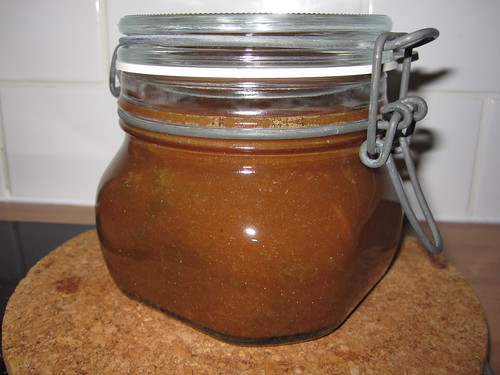
Because I used so much dark sugar, the jam is quite dark in colour, but looking at the first time I made rhubarb jam, it was pretty dark too, even.
IMG_5931

We've not tried it yet, as we already have several other jams "on the go" as Lundulph says and I'm not opening another one until we've finished these.

19 August 2010

Wiener Apfelstrudel

I got talking to our neighbours the other day. Their apple tree is bent over with fruit and they very kindly gave me a tray of apples, not being sure what to do with all the fruit and telling me to help myself wherever I can reach. They are cooking apples, they said, but can be eaten if really desperate.

IMG_0918_cropped

So I washed the apples and lined them up to dry and racked my brain and my cook books on what to do with them. Then it struck me - strudel! It's been ages since I had it, in Munich in fact in 1996, and I've not thought of having go at making one myself.

So a quick google later and I found two recipes. The first one was in pictures and and looked pretty straight forward, but on reading it through, it talked about letting the dough rest in the oven at 50 degrees C. Unfortunately the lowest setting on my oven is S, for slow cooking and is just over 100 degrees C, so I thought I'd have to skip it.

The second one, however also had a better way of dealing with the "rest in a warm place" thing.

This resting of the dough in a warm environment is a new technique to me, I wonder what the chemistry and physics are behind it. It wasn't in my food science book as far as I remember anyway. I had my doubts, but it most definitely worked. I followed the second recipe, along with the photos of the first one. By the way both are in German, so you might want to run them through google translate. As always, I had to make some changes, due to lack of certain ingredients.

Ingredients

Dough
200 g strong flour
5 tbsp water at room temperature
50 g unsalted butter
1 ml salt


Filling
about 1 kg apples
zest of 1 lemon
2 tbsp dark rum
5 ml vanilla essence
75 g unsalted butter
100 g caster sugar
1 tsp ground cinnamon
50 g finely ground breadcrumbs
50 g sultanas
50 g chopped nuts
1 egg yolk (optional)
icing sugar for dusting


Method
  1. Half-fill a heavy lidded saucepan with water, put the lid on and bring to the boil.

  2. In a small saucepan, melt the butter on low heat.

  3. Sift the flour into a bowl, add the water, salt and the melted butter and stir together into a dough. Take it out onto a work surface and knead it for a few minutes.

  4. When the water has boiled, switch off the hob and pour out the water. Dry the saucepan and the lid and return to the hob, then shape the dough into a ball and place in the saucepan and cover. Let rest for 30 minutes.

  5. Now peel the apples, quarter and remove the seeds. You should end up with about 850 g of cleaned apple pieces, then cut into juliennes or small dice and place in a bowl.

  6. Grate the lemon zest over the apples and also add the rum and vanilla essence, then stir through to mix as evenly as possible.

  7. Melt the butter on low heat, once melted switch off the hob. Mix the caster sugar and the cinnamon in a bowl and set aside. Pre-heat the oven to 180 degrees C.

  8. Place a large clean kitchen towel on the work surface and dust liberally with flour. Take out the dough after it's rest and place on the towel and start rolling it out until it begins to go transparent.
    IMG_0914

  9. Brush the dough very sparingly with some of the melted butter, then start stretching it by hand. A method for this is to pick up the dough and let it hang off your knuckles and letting gravity stretch for you, but this requires practice and speed, as it can tear quite easily. You want to end up with a transparent rectangle of 50 x 70 cm approximately.

  10. Brush with about two-thirds of the melted butter, then sprinkle the breadcrumbs.

  11. Then spread the apples over the whole surface, except the outer 3 cm of each of the short sides of the dough rectangle. Follow with the sultanas and the chopped nuts.

  12. Finally sprinkle the cinnamon sugar over the filling.

  13. Now, fold the two bare doug strips of the short sides over the apple filling, then carefully pick up two corners of the long edge of the towel and use it to roll up the strudel. Continue all the way until it's all rolled up, tucking in the sides where they try to unfold.

  14. Line a baking tray with baking paper, then turn over the strudel. If it won't fit, bend it very carefully into a horse shoe shape.

  15. Using the towel edges to wrap around the baking tray, swiftly flip the whole caboodle, so the strudel ends up in the baking tray and the towel regains its freedom.

  16. Bake in the middle of the oven for 30 minutes, then take out and brush with the remaining melted butter, then continue baking for a further 15 - 30 minutes, until the strudel gets a golden brown tinge.

  17. Let cool before serving.


This resting the dough in a warm pot was very novel and although it felt a bit tough when I put it in the pot, when I took it out, it was as soft and stretchy as anything. I just need to work faster to avoid it drying out. I did over-stretch in a couple of places and it broke, but the holes were quite small. I should have worked on getting thinner edges too.

IMG_0915

I wasn't too good with the swift flip, and my towel wasn't big enough and I struggled to wrap it around the baking tray. Besides I also fidgeted too much with taking photos and this and that and the dough dried out a bit and was even more fragile, so some of the apple filling fell out and will make an interesting addition to my cereal tomorrow.

IMG_0916

I actually also made a few mistakes during the making - I forgot to add the vanilla essence to the apples, so used my recently purchased dropper to sprinkle the essence around. It sort of worked, I think. I was also worried that I'd over-done the rum, the apples smelt quite strongly of it, but after baking it blended in with the other flavours.

The sultanas might seem like ridiculously few, but don't be tempted to add more, once the strudel is rolled up it'll be fine.

I also brushed the remaining butter before putting the strudel in the oven, not after 30 minutes, so will try out brushing with egg yolk next time, to give it a bit more shine, though the strudels I've had in cafés have all been dusted heavily with icing sugar, so it doesn't really matter if the surface is shiny or not. I ended up baking my strudel for 55 minutes.

IMG_0917

And what did it taste like? Like a rather nice strudel actually, though the apples were perhaps a bit on the sour side, I should have used a bit more sugar, but Lundulph liked it and said less sugar is better. The dough was nice and crispy, but not as brittle as filo or puff pastry.

I was just so amazed that I succeeded in rolling and stretching the dough into transparentness. You see, I've made filo pastry once in my life and that's many years ago and under the supervision of a friend who was a very experienced filo baker. That dough was not kept warm, but was rolled and stretched and resulted in a similarly thin sheet. I also foolishly didn't note down the recipe. But after this experience, I'm quite keen to try making filo as well.

This has used up about two-thirds of the apples, I'll have to think up something else do with the remainder.

11 April 2009

A Special Dessert

One of the blogs I read regularly is Rice and Wheat and just over a month ago, Angi had written an entry about a Baumkuchen or a tree cake. Her photos were so beautiful and the whole method of making was so different from what I've come across so far, it went straight to my list of things to cook in 2009.

IMG_4211

Her lovely version can be found here.

And the Easter week-end was this opportunity. Angi also kindly allowed me to publish her recipe, albeit in metric.

Ingredients

2.5 dl flour, sifted
2.5 dl cornstarch, sifted
1 ml salt
0.75 dl ground almonds
227 g unsalted butter, cut into small pieces and softened at room temperature
1.77 dl sugar
8 eggs, separated
2 tbsp dark rum
zest of 1 lemon
1.18 dl apricot jam

Chocolate Icing

114 g unsalted butter
170 g dark chocolate
3 tbsp light maple syrup
3 tbsp dark rum

I don't have a broiler in my oven, but I've guessed that this corresponds to the English grill - so I pre-heated it on medium-high. I only have an 8" cake tin and a 12" one, so I opted for the smaller one and I greased it with butter. I think this is one cake where a springform really makes sense, by the way.

I also have not been able to find corn flour and from what I remember from my readings it's quite popular in making confectionery since it prevents other sugars from crystallising. I made the choice of swapping this for maple syrup, without any scientific basis.

I followed Angi's instructions on the batter, but I think I should have sifted the flours first and then measured them, as my batter was a lot thicker than I expected. That's a problem when you measure by volume - sifting incorporates air into it and the same volume will weigh a lot less and thus result in a thinner, runnier batter. The whole mixing took me just under an hour and a half, so in hindsight, I should have started pre-heating the grill in the last 20 minutes or so.

Even after folding in the egg whites, it was fairly stiff, so when I tried to brush the first layer of the cake, most of it stayed on the brush.

IMG_4189

So from layer two onwards, I used a ladle and a dough scraper. Half-way through the layers, I began to worry that dropping half an inch in cake tin size relative to Angi's recipe would result in leftover cake mix. But somehow it all went in, just about. Here is the last layer, nr 12.

IMG_4191

I did get hold of some wonderful apricot jam. I only bought it because it seemed to be the smoothest one on the shelf, the other brands seemed to go for chunky style. And I was surprised that there were quite few options on apricot jam, I've always thought it's a staple alongside of strawberry and raspberry jams. What also seemed good about this one that it claimed to be made with no added sugar, but with some sort of concentrated fruit juice. I don't know, but it was very tasty. It's called St Dalfour Fruit Spread Thick Apricot.

It melted nicely, at which point I worried that it wouldn't stay on the cake, but I let it cool a bit and it just about stayed on.

IMG_4194

Obviously the layers should have been a lot thinner, but these 12 layers took also an hour and a half in total.

And now comes the difficult part - the icing. I've never had any success with mixing chocolate and butter - it keeps separating. Admittedly this time wasn't as disastrous as the icing for the eclair challenge from The Daring Bakers. I spread it over the cake despite everything. The sides were particularly difficult. And I put the candied violet flowers on top. They started soaking up some of the fat, so I put the whole cake in the fridge overnight. The next day, the whole looked well set and dull with small areas of yellowy fat. I tried scraping them off, which didn't really work. But luckily, with the given amount of icing, I'd only used half the amount and was able to remove most of the fat from the leftover icing, stirred it round a bit and put a second layer on the cake, after removing the violets. This worked better, so my new chocolate - butter theory is that if there's too much butter, it'll separate out, i e there's so much fat chocolate will take. To be on the safe side, I don't intend to try experimenting further, chocolate is too precious for that.

I served the cake as dessert and it was impressive.

IMG_4213

Though Lundulph's first reaction was to comment that it needs cream. And he's right - the cake was very dry indeed, so some sort of moisturising exercise is definitely in order. And as I said before - sift before measure for a runnier cake mix and thinner layers. Angi said she finds the brushing on of the layers relaxing and I suspect it is, once you've got the hang of it.

Many thanks Angi for this interesting recipe.